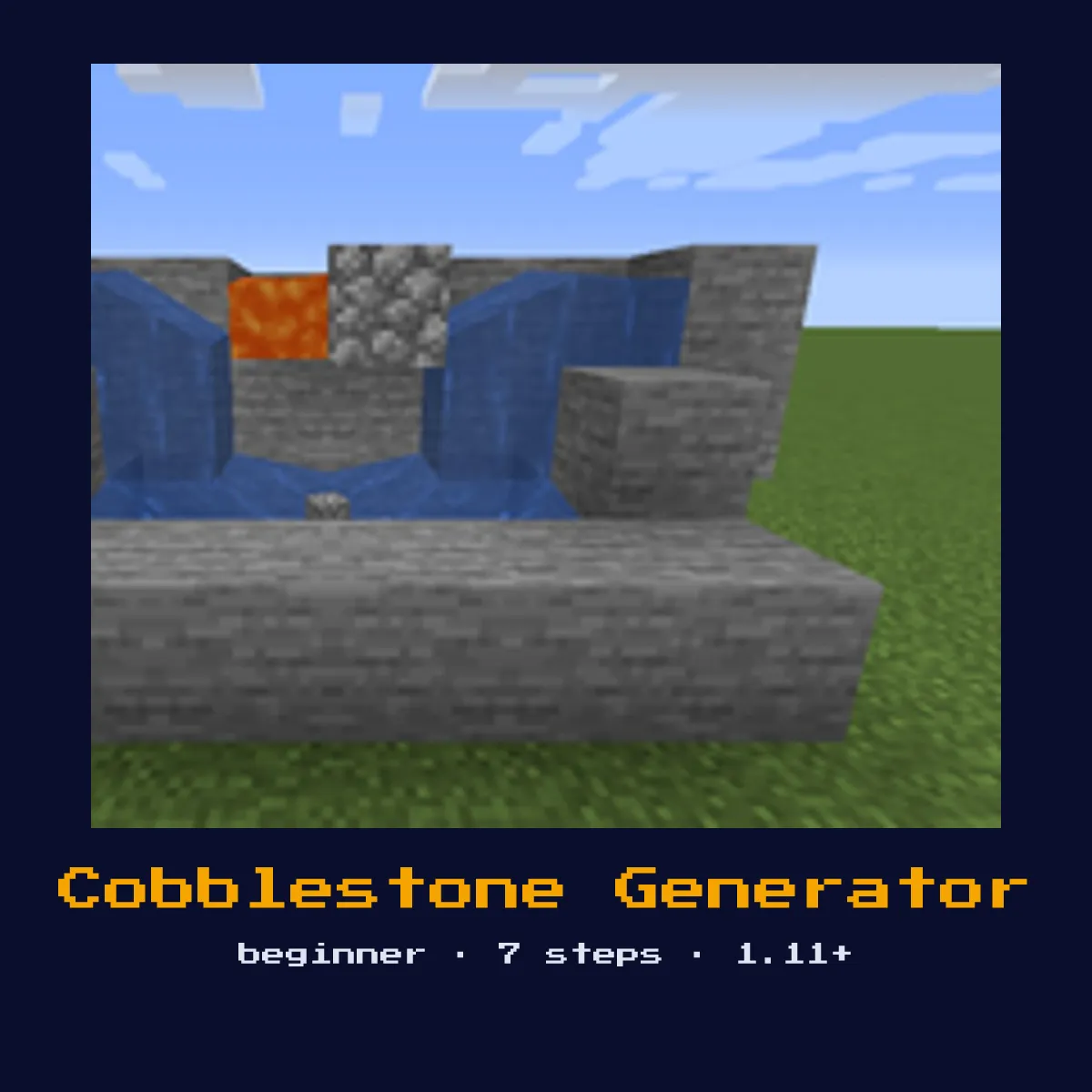
COBBLESTONE GENERATOR
Generates infinite cobblestone where water meets lava. An observer detects the new cobblestone and a piston pushes it into a line for collection. Fully automatic and self-sustaining.

Materials List
Materials for Cobblestone Generator, and the price of each
Adding up the recipes behind those parts, one Cobblestone Generator costs 32 crafting ingredients in total: 11 Planks, 10 Cobblestone and 6 Iron Ingot, plus 3 more kinds.
You can read up on Piston, Observer and Hopper separately; those pages carry the delay and power figures this Cobblestone Generator depends on.
| Cobblestone Generator needs this | Quantity per Cobblestone Generator | One of these costs you |
|---|---|---|
 Piston Piston | 1 | 4 Cobblestone, 3 Planks, 1 Iron Ingot, 1 Redstone |
 Observer Observer | 1 | 6 Cobblestone, 2 Redstone, 1 Quartz |
 Hopper Hopper | 1 | 5 Iron Ingot, 1 Chest |
 Chest Chest | 1 | 8 Planks |
A complete Cobblestone Generator, counted in ingredients
 11 Planks
 10 Cobblestone
 6 Iron Ingot
 3 Redstone
- 1 Chest
 1 Quartz
Java Edition 26.2 recipes are where these Cobblestone Generator numbers come from.
What the Cobblestone Generator is, and what it does for you
Generates infinite cobblestone where water meets lava. An observer detects the new cobblestone and a piston pushes it into a line for collection. Fully automatic and self-sustaining.
As a utility build it automates a processing job, smelting, brewing, composting, or generating a resource, to save repetitive manual work. It is a beginner-friendly build: the wiring is forgiving and a first-time redstoner can finish it in one sitting.
It fits in roughly 3W x 5L x 2H and works in Minecraft 1.11+ through to the current 26.2 release.
The Cobblestone Generator from the inside: what drives what
Where a water flow meets a lava source, cobblestone forms in the gap. An observer watches that exact spot and fires a piston the instant new stone appears, shoving it along a line toward a hopper. Because the water and lava reform immediately, the supply is effectively infinite.
The core parts doing the work are water Bucket, lava Bucket, piston, observer, and hopper; the rest of the 7 material types are structure and wiring that hold those pieces in the right relationship.
Because it automates a processing step, the limiting factor is the machine's own cycle time, and the redstone simply has to feed it in the correct order and rhythm.
How to lay out a Cobblestone Generator
- 1Build a trench: 1 block wide, 1 block deep, at least 4 blocks long.
- 2Place water at one end (flows toward center).
- 3Place lava at the other end (meets water in the middle, forming cobblestone).
- 4Place an observer watching the cobblestone generation point.
- 5Place a piston that pushes the new cobblestone sideways or forward.
- 6Connect the observer to the piston, it triggers every time new cobblestone forms.
- 7At the end of the push line, let blocks drop into a hopper for collection.
Uses & applications of the Cobblestone Generator
- ▸As a utility build it automates a processing job, smelting, brewing, composting, or generating a resource, to save repetitive manual work.
- ▸Built from 1× water Bucket, 1× lava Bucket, 1× piston, and 1× observer and more, it slots into a survival base as a beginner-level project.
- ▸Connect its input and output chests to a wider item network so it processes resources unattended.
- ▸Scale the array up by repeating the unit once the single version works.
Tips & common mistakes
- !The observer must watch the precise block where cobble generates; aimed a block off, it never sees the new stone and the piston stays idle.
- !Try all 7 steps in a flat creative world first. The Cobblestone Generator is forgiving as these builds go, but one wrong facing can still cost you the whole thing.
- !Keep total moved blocks under the 12-block piston limit, and feed sticky pistons a pulse of at least 2 ticks so they pull their block back instead of dropping it.
Cobblestone Generator, frequently asked questions
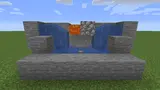
How do you build a Cobblestone Generator in Minecraft?
Build a trench: 1 block wide, 1 block deep, at least 4 blocks long. Place water at one end (flows toward center). The full build takes 7 material types and fits in about 3W x 5L x 2H.

What materials does a Cobblestone Generator need?
The main materials are 1× water Bucket, 1× lava Bucket, 1× piston, and 1× observer, plus the remaining structural and wiring blocks.
How hard is the Cobblestone Generator to build?
It is a beginner-friendly build: the wiring is forgiving and a first-time redstoner can finish it in one sitting. It is compatible with Minecraft 1.11+ and later.

How does the Cobblestone Generator actually work?
Where a water flow meets a lava source, cobblestone forms in the gap. An observer watches that exact spot and fires a piston the instant new stone appears, shoving it along a line toward a hopper. Because the water and lava reform immediately, the supply is effectively infinite.
Builds that share parts with Cobblestone Generator
Follow Cobblestone Generator further into the site through these 5 contraption pages: