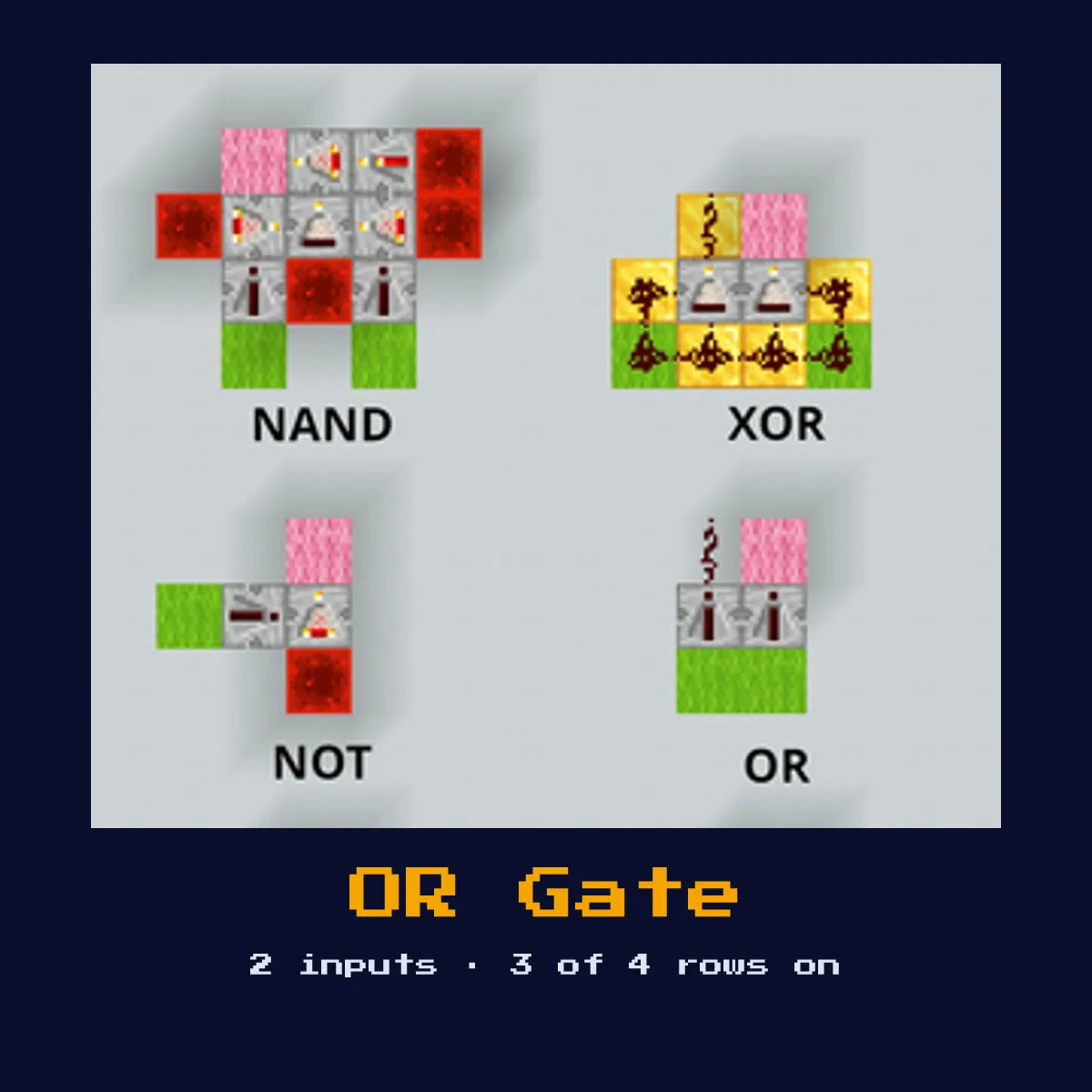
OR GATE
Outputs ON when ANY input is ON. The simplest multi-input gate, just merge two redstone dust lines into one. No torches needed for basic OR functionality.

Truth Table
| Input A | Input B | Output |
|---|---|---|
| 0 (OFF) | 0 (OFF) | 0 (OFF) |
| 0 (OFF) | 1 (ON) | 1 (ON) |
| 1 (ON) | 0 (OFF) | 1 (ON) |
| 1 (ON) | 1 (ON) | 1 (ON) |
Reading the OR Gate truth table
Count the rows and the OR Gate is quickly summed up: 4 states, 3 on, 1 off.
Because only one row of the OR Gate table reads off, that off state is what circuits usually watch for.
Every one of the 4 rows of an OR Gate is the opposite of the NOR Gate, so one redstone torch on the output turns either into the other.
Closest to the OR Gate sits the XOR Gate (Exclusive OR), which differs on a single row of the table, so a wiring mistake between them is easy to make and easy to miss.


OR Gate materials, and what they cost to craft
An OR Gate scales with how many parts you chain, and each one has its own price: one Redstone Torch costs 1 Redstone and 1 Stick and one Redstone Repeater costs 3 Stone, 2 Redstone Torch and 1 Redstone.
| Goes into OR Gate | Count in one OR Gate | Price of a single one |
|---|---|---|
 Redstone Torch Redstone Torch | as many as the build needs | 1 Redstone, 1 Stick |
 Redstone Repeater Redstone Repeater | as many as the build needs | 3 Stone, 2 Redstone Torch, 1 Redstone |
Every OR Gate figure in this table is read off the Java Edition 26.2 recipes.
Start here: what an OR Gate is and what it does
Outputs ON when ANY input is ON. The simplest multi-input gate, just merge two redstone dust lines into one. No torches needed for basic OR functionality.
In plain terms, the output is on whenever at least one input is on. OR is the most natural gate in redstone because two dust lines that simply meet already behave as one, it is how you let any of several triggers fire the same mechanism.
No mods and no datapacks are involved: this is the OR Gate exactly as Java Edition 26.2 builds it, down to the tick counts in the table.
Reading the OR Gate: inputs, output and timing
Across its four input combinations the output is on in 3 cases, A off with B on, A on with B off, and A on with B on, and off in the remaining 1.
Expressed as boolean algebra that is output = A OR B.
A bare dust-merge OR adds no delay at all; only the optional isolating repeaters on each input cost ticks.
The 4 rows above are written out as on and off rather than as numbers, because the OR Gate ignores how strong the incoming signal happens to be and only ever asks whether there is any signal there at all.
Building the OR Gate, step by step
- 1Run input A as redstone dust toward the output point.
- 2Run input B as redstone dust toward the same output point.
- 3Where the two dust lines meet, they naturally combine into an OR gate.
- 4If either input has signal, the output will be powered.
- 5For isolation, use repeaters on each input before merging.
- 6The OR Gate is only finished when all 4 rows of its table hold true: setting the inputs to OFF and ON is the first one to try, and the output should read ON when you do.
Uses & applications
- ▸OR is the most natural gate in redstone because two dust lines that simply meet already behave as one, it is how you let any of several triggers fire the same mechanism.
- ▸Direct dust merge (simplest, just join two lines), a practical build choice for this gate.
- ▸Repeater-isolated OR (prevents signal backflow), a practical build choice for this gate.
- ▸Multi-input OR (just add more lines to the merge point), a practical build choice for this gate.
Tips & common mistakes
- !If the OR Gate reads even one row of its truth table wrong, go looking for two dust lines touching somewhere behind it before you start doubting the logic of the gate itself.
- !Remember the propagation cost: A bare dust-merge OR adds no delay at all; only the optional isolating repeaters on each input cost ticks. If you chain several gates, those ticks add up and can desynchronise a fast circuit.
- !Debug from the smallest piece upwards. The OR Gate has only 4 states to check, so proving that it is right takes less than a minute of your time.
OR Gate FAQ
What does an OR Gate do in Minecraft?
A OR Gate outputs a signal where the output is on whenever at least one input is on. In boolean terms, output = A OR B.

What is the truth table of an OR Gate?
Across its four input combinations the output is on in 3 cases, A off with B on, A on with B off, and A on with B on, and off in the remaining 1. The boolean expression is output = A OR B.

How do you build an OR Gate with redstone?
Run input A as redstone dust toward the output point. Run input B as redstone dust toward the same output point. Common variants include direct dust merge (simplest, just join two lines) and repeater-isolated OR (prevents signal backflow).
How much delay does an OR Gate add?
A bare dust-merge OR adds no delay at all; only the optional isolating repeaters on each input cost ticks. That matters most in clocks and adders where every redstone tick counts.