XNOR GATE (EXCLUSIVE NOR)
Outputs ON when both inputs are the same (both ON or both OFF). The inverse of XOR. Used for equality comparison, combination locks, and parity circuits.

Truth Table
| Input A | Input B | Output |
|---|---|---|
| 0 (OFF) | 0 (OFF) | 1 (ON) |
| 0 (OFF) | 1 (ON) | 0 (OFF) |
| 1 (ON) | 0 (OFF) | 0 (OFF) |
| 1 (ON) | 1 (ON) | 1 (ON) |
Reading the XNOR Gate (Exclusive NOR) truth table
Count the rows and the XNOR Gate (Exclusive NOR) is quickly summed up: 4 states, 2 on, 2 off.
The only way to light an XNOR Gate (Exclusive NOR) is with A off and B off or with A on and B on.
The XOR Gate (Exclusive OR) is the XNOR Gate (Exclusive NOR) with an inverter bolted on. All 4 rows come out the other way round.
Closest to the XNOR Gate (Exclusive NOR) sit the AND Gate and NOR Gate, which differ on a single row of the table, so a wiring mistake between them is easy to make and easy to miss.
How far the other gates sit from XNOR Gate (Exclusive NOR)


The material cost of one XNOR Gate (Exclusive NOR)
Behind the XNOR Gate (Exclusive NOR) parts list sits 12 crafting ingredients: 6 Redstone and 6 Stick.
Redstone Torch and Redstone Comparator each have their own page here, with the signal behaviour and block values that decide how the XNOR Gate (Exclusive NOR) times out.
| Part used in XNOR Gate (Exclusive NOR) | How many per XNOR Gate (Exclusive NOR) | Crafting cost of a single one |
|---|---|---|
 Redstone Torch Redstone Torch | 6 | 1 Redstone, 1 Stick |
 Redstone Comparator Redstone Comparator | as many as the build needs | 3 Redstone Torch, 3 Stone, 1 Quartz |
The full shopping list for XNOR Gate (Exclusive NOR)
 6 Redstone
 6 Stick
Prices for XNOR Gate (Exclusive NOR) are read straight off the recipes in Java Edition 26.2.
The XNOR Gate (Exclusive NOR) in short: what it is and what it does
Outputs ON when both inputs are the same (both ON or both OFF). The inverse of XOR. Used for equality comparison, combination locks, and parity circuits.
In plain terms, the output is on when both inputs are the same, whether both on or both off. XNOR is the equality gate: it answers 'do these two signals match?', which makes it the natural core of combination locks and bit-comparison circuits.
No mods and no datapacks are involved: this is the XNOR Gate (Exclusive NOR) exactly as Java Edition 26.2 builds it, down to the tick counts in the table.
How the XNOR Gate (Exclusive NOR) works: the redstone mechanics
Across its four input combinations the output is on in 2 cases, A off with B off and A on with B on, and off in the remaining 2.
Expressed as boolean algebra that is output = NOT (A XOR B).
Built as XOR followed by a NOT gate, it adds one extra redstone tick on top of the XOR it is based on.
The 4 rows above are written out as on and off rather than as numbers, because the XNOR Gate (Exclusive NOR) ignores how strong the incoming signal happens to be and only ever asks whether there is any signal there at all.
How to wire up a XNOR Gate (Exclusive NOR)
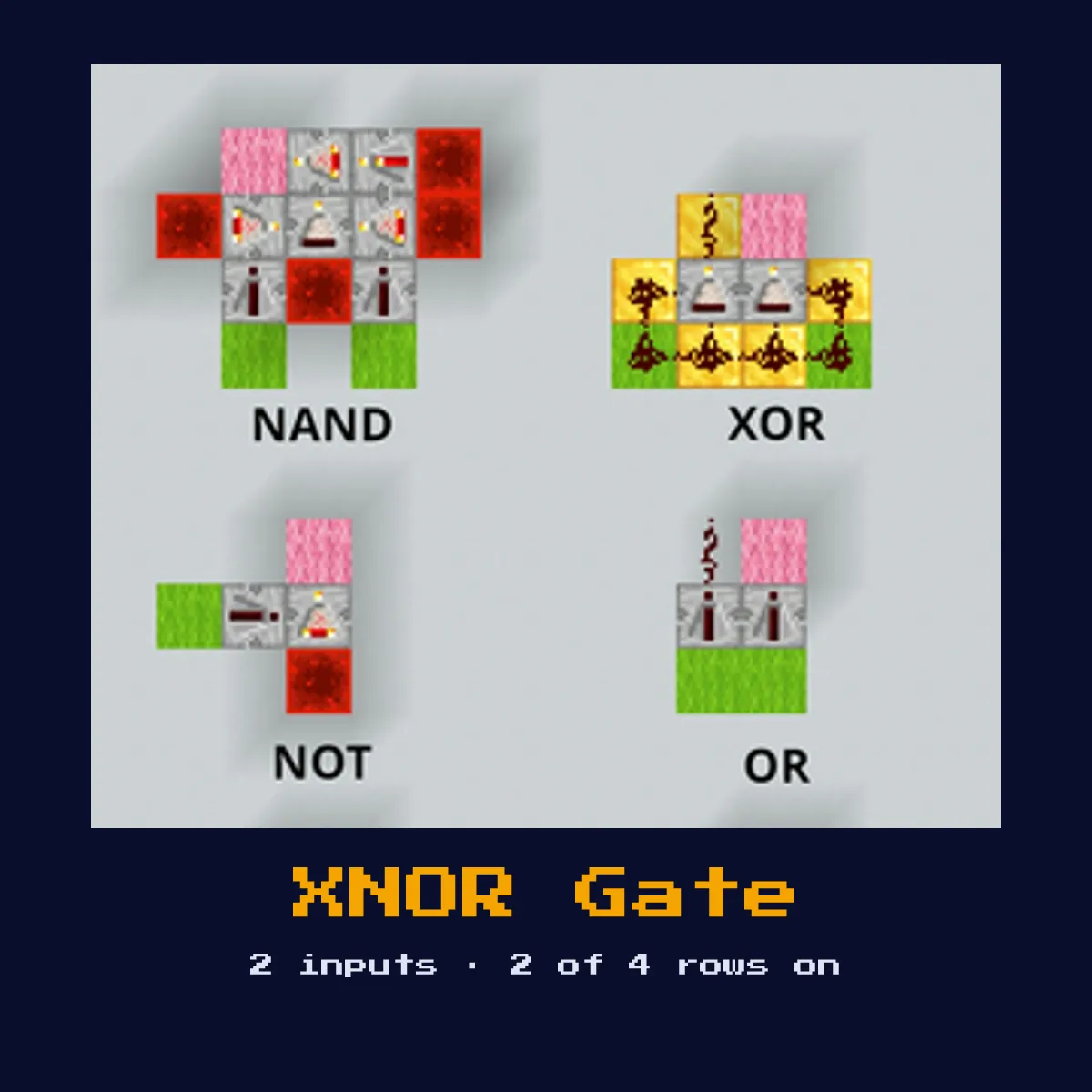
- 1Build an XOR gate (see XOR instructions).
- 2Add a NOT gate (block + torch) to the XOR output.
- 3The result inverts the XOR, giving XNOR behavior.
- 4Alternative: Use comparators in compare mode, output is ON when both inputs match.
- 5Verify it against the truth table: setting the inputs to OFF and OFF should drive the output ON. Walk through all 4 input combinations once to confirm the gate matches the table above.
Where the XNOR Gate (Exclusive NOR) earns its keep
- ▸XNOR is the equality gate: it answers 'do these two signals match?', which makes it the natural core of combination locks and bit-comparison circuits.
- ▸XOR + NOT (simplest, add inverter to XOR output), a practical build choice for this gate.
- ▸Comparator XNOR (two comparators in compare mode feeding OR), a practical build choice for this gate.
- ▸6-torch XNOR (compact torch-only design), a practical build choice for this gate.
- ▸Combination lock core (check if input matches key), a practical build choice for this gate.
Tips & common mistakes
- !Keep your inputs isolated with repeaters if signals are flowing back into each other; uncontrolled backflow between dust lines is the most common reason a gate reads the wrong value.
- !Remember the propagation cost: built as XOR followed by a NOT gate, it adds one extra redstone tick on top of the XOR it is based on. If you chain several gates, those ticks add up and can desynchronise a fast circuit.
- !When a multi-gate circuit misbehaves, test each gate in isolation against its own truth table before assuming the wiring between them is at fault.
XNOR Gate (Exclusive NOR) FAQ
What does a XNOR Gate (Exclusive NOR) do in Minecraft?
A XNOR Gate (Exclusive NOR) outputs a signal where the output is on when both inputs are the same, whether both on or both off. In boolean terms, output = NOT (A XOR B).

What is the truth table of a XNOR Gate (Exclusive NOR)?
Across its four input combinations the output is on in 2 cases, A off with B off and A on with B on, and off in the remaining 2. The boolean expression is output = NOT (A XOR B).
How do you build a XNOR Gate (Exclusive NOR) with redstone?
Build an XOR gate (see XOR instructions). Add a NOT gate (block + torch) to the XOR output. Common variants include XOR + NOT (simplest, add inverter to XOR output) and comparator XNOR (two comparators in compare mode feeding OR).

How much delay does a XNOR Gate (Exclusive NOR) add?
Built as XOR followed by a NOT gate, it adds one extra redstone tick on top of the XOR it is based on. That matters most in clocks and adders where every redstone tick counts.