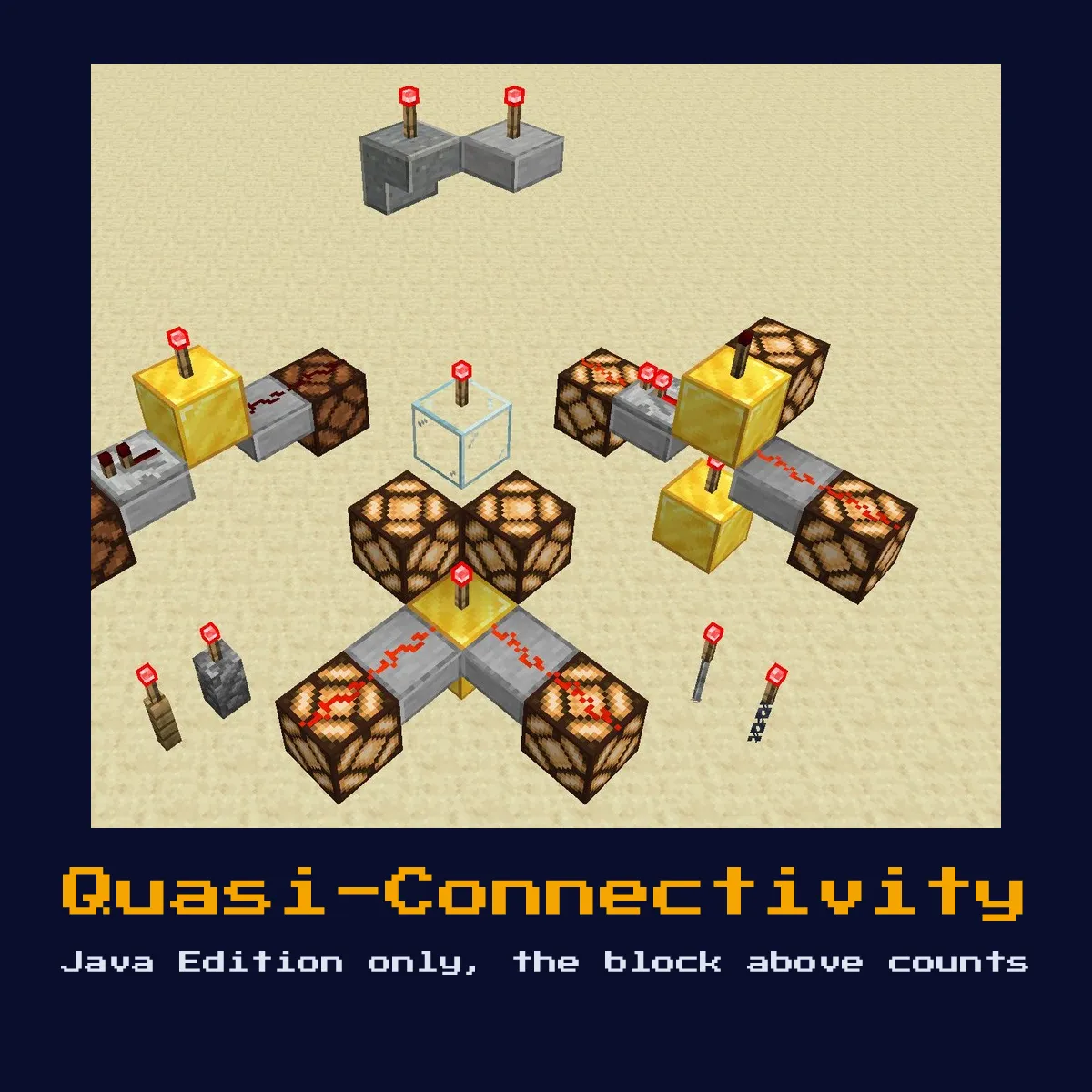
QUASI-CONNECTIVITY
Quasi-connectivity (QC) is a Java Edition-only mechanic where pistons, dispensers, and droppers can be activated by power sources that would activate the space above them. This quirk is widely used in advanced redstone builds.
What Is Quasi-Connectivity?
In Java Edition, pistons, dispensers, and droppers check for power not only at their own position, but also at the block position directly above them. If the block above would be powered (even if there is no block there), the component activates.
This means a redstone signal 2 blocks above a piston can power it, even without any redstone dust connecting them directly. The piston behaves as if it occupies both its own space and the space above.
This mechanic does NOT exist in Bedrock Edition, making it a major source of cross-platform redstone incompatibility.

Affected Components


How It Works (Step by Step)
- 1Place a piston at position (x, y, z).
- 2Place a redstone power source (dust, repeater, etc.) that would power position (x, y+1, z), the block above the piston.
- 3The piston receives a block update and checks: "Would the space above me be powered?"
- 4If yes, the piston activates, even though no redstone touches it directly.
- 5Important: The piston needs a block update to notice the change. It will not activate until something near it updates.
The Block Update Requirement
Quasi-connectivity has a critical nuance: the affected component must receive a block update to check for QC power. Simply powering the space above is not enough if no update reaches the component.
This is why QC-powered pistons sometimes appear "stuck", they are powered via QC but have not received a block update to notice. Placing or breaking any adjacent block (or running redstone dust nearby) provides the update.
This behavior is the basis for BUD (Block Update Detector) switches, which deliberately exploit the disconnect between power state and update timing.
Common Uses of Quasi-Connectivity
BUD Switches
Detect any block update nearby. QC powers a piston, then a nearby block change triggers it. Used before observers were added.
Compact Piston Doors
Power pistons from above without running dust directly to them. Saves space in tight builds.
Double Piston Extenders
QC lets the bottom piston be powered by a signal aimed at the top piston position, enabling compact 2-high extension.
Flush Piston Doors
Floor and ceiling pistons can be powered from above without visible wiring, creating cleaner flush designs.
Java vs Bedrock Compatibility
Quasi-connectivity does NOT exist in Bedrock Edition. Any redstone build that relies on QC will NOT work on Bedrock.
If you are building for cross-platform compatibility (or for Bedrock specifically), you must wire power directly to each component. Do not rely on powering the space above a piston or dispenser.
Many popular Java redstone tutorials use QC without mentioning it. If a build seems to power a piston "magically" from above, it is using QC and will not port to Bedrock.