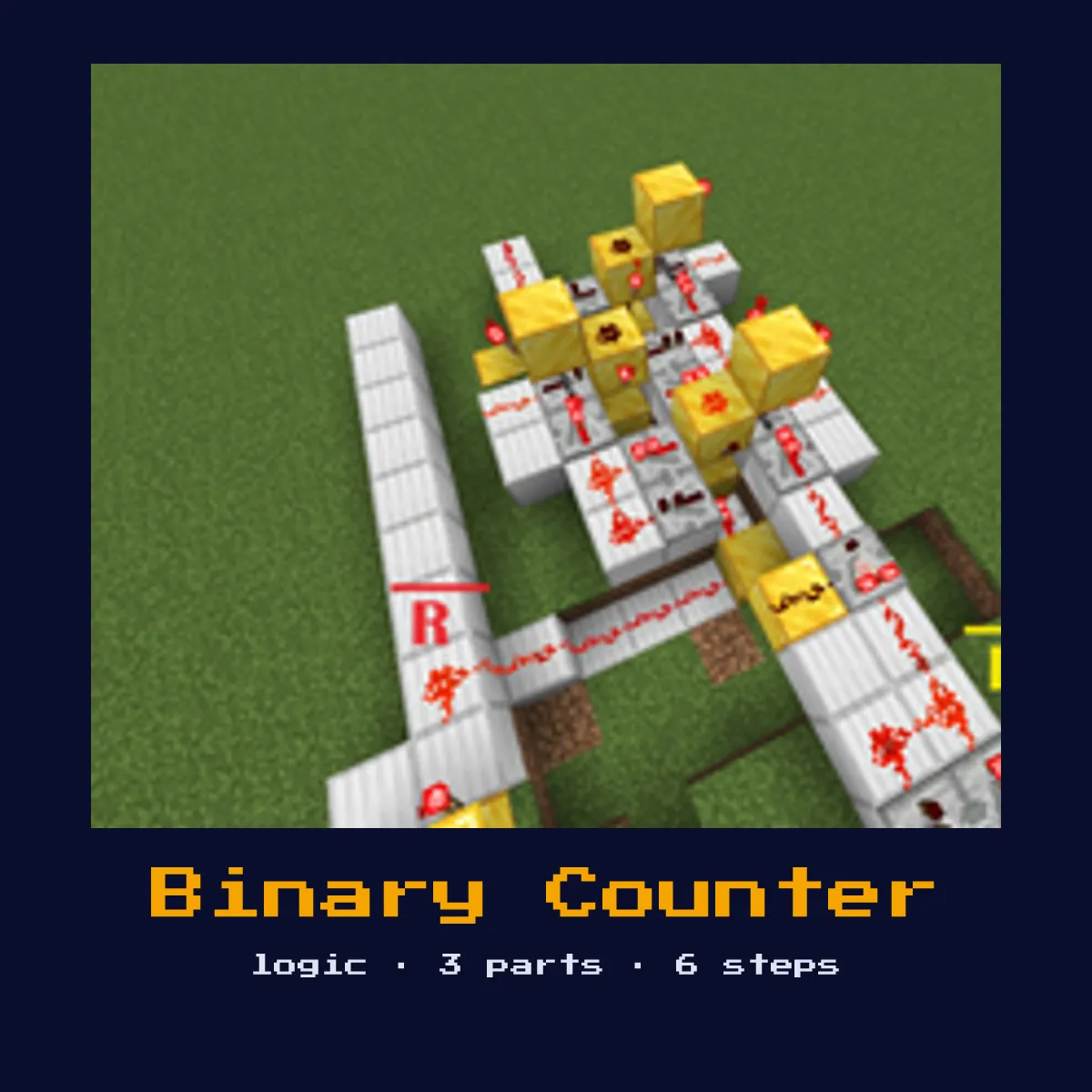
BINARY COUNTER
Counts input pulses in binary. Each T flip-flop represents one bit. The first flip-flop toggles every pulse, the second every 2 pulses, etc. Can count up to 2^n - 1.

When to Use
Item counting, score tracking, combination locks, sequential event triggering, redstone computers.
Materials
- Multiple T Flip-Flops (dropper + hopper each)
 Redstone Dust
 Repeaters
Binary Counter materials, and what they cost to craft
The Binary Counter parts list leaves the count open, so work from the price of a single part: one Redstone Repeater costs 3 Stone, 2 Redstone Torch and 1 Redstone.
| Goes into Binary Counter | Count in one Binary Counter | Price of a single one |
|---|---|---|
| Redstone Repeater | as many as the build needs | 3 Stone, 2 Redstone Torch, 1 Redstone |
Every Binary Counter figure in this table is read off the Java Edition 26.2 recipes.
What the Binary Counter is, and what it does for you
Counts input pulses in binary. Each T flip-flop represents one bit. The first flip-flop toggles every pulse, the second every 2 pulses, etc. Can count up to 2^n - 1.
As a logic circuit it routes, counts, or decodes signals, forming the building blocks that scale up into redstone computers.
The Binary Counter earns its place in item counting, score tracking, combination locks, sequential event triggering, redstone computers. Everything written on this page is vanilla Java Edition 26.2 behaviour.
How the Binary Counter works: the redstone mechanics
Each T flip-flop in the chain is one binary bit: the first toggles every pulse, the second every two pulses, the third every four, and so on, so n flip-flops count from 0 up to 2^n − 1 before rolling over. A shared reset line clears every bit at once.
3 kinds of block go into the Binary Counter, and not one of them is there for decoration: multiple T Flip-Flops (dropper + hopper each), redstone Dust, and repeaters. Each has a timing or a logic job to do.
Because this is a logic circuit, the thing to watch as you build is signal isolation between stages, so one part of the logic does not back-feed into another.
Building the Binary Counter, step by step
- 1Build a chain of T flip-flops (one per bit of your counter).
- 2Connect the output of the first flip-flop to the input of the second.
- 3Connect each subsequent output to the next input.
- 4Feed your count pulses into the first flip-flop's input.
- 5Read the binary value from all flip-flop outputs (LSB = first, MSB = last).
- 6Add a reset line to all flip-flops to clear the counter.
- 7Power it up and watch one full cycle: confirm it drives the correct output for each input combination before wiring it into a larger contraption.
Uses & applications of the Binary Counter
- ▸Item counting, score tracking, combination locks, sequential event triggering, redstone computers.
- ▸Ripple counter (simple chain, slight propagation delay), a variant suited to particular space or timing needs.
- ▸Synchronous counter (all bits update simultaneously, more complex), a variant suited to particular space or timing needs.
- ▸Up/down counter (reversible counting direction), a variant suited to particular space or timing needs.
- ▸Decade counter (resets at 10, uses feedback reset), a variant suited to particular space or timing needs.
Tips & common mistakes
- !In a simple ripple chain each bit waits for the one before it, so very fast input pulses can outrun the carry, slow the input or build a synchronous counter.
- !Build and verify each logic stage on its own before connecting them; debugging a full multi-stage circuit at once is far harder.
- !Remember that bare redstone dust loses 1 signal strength per block, so insert a repeater before any run exceeds 15 blocks inside this circuit.
The Binary Counter FAQ, answered

What is a Binary Counter used for?
A Binary Counter is used for item counting, score tracking, combination locks, sequential event triggering, redstone computers. As a logic circuit it routes, counts, or decodes signals, forming the building blocks that scale up into redstone computers.

What do you need to build a Binary Counter?
You need multiple T Flip-Flops (dropper + hopper each), redstone Dust, and repeaters. Build a chain of T flip-flops (one per bit of your counter).
How does a Binary Counter work?
Each T flip-flop in the chain is one binary bit: the first toggles every pulse, the second every two pulses, the third every four, and so on, so n flip-flops count from 0 up to 2^n − 1 before rolling over. A shared reset line clears every bit at once.

Are there different versions of the Binary Counter?
Yes, common variants include ripple counter (simple chain, slight propagation delay), synchronous counter (all bits update simultaneously, more complex), up/down counter (reversible counting direction), and decade counter (resets at 10, uses feedback reset). Pick the one that fits your available space and timing requirements.

How high can a redstone binary counter count?
A binary counter with n bits (n T flip-flops) counts from 0 to 2^n − 1, then rolls over to 0. Four flip-flops reach 15, eight reach 255. Add more flip-flops to the chain to extend the range.
Circuits that share parts with Binary Counter
Follow Binary Counter further into the site through these 5 circuit pages: