COMMON CIRCUITS
Essential redstone circuits, clocks, pulse shapers, memory cells, and logic building blocks.
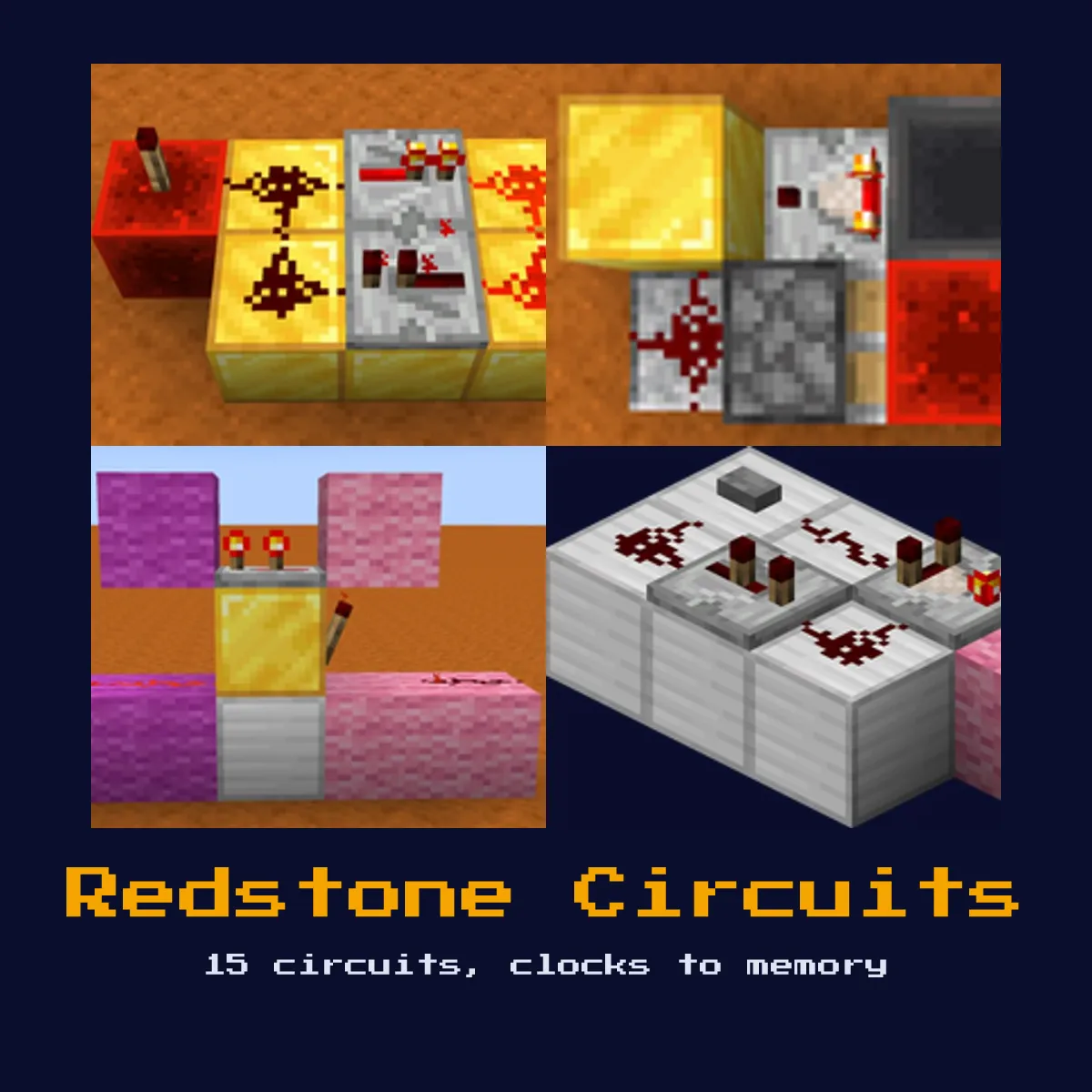
A circuit is what you get when gates and components start working together: something that keeps time, remembers a state, shortens a pulse or picks one line out of several. This page has 15 of them, in 4 groups: 4 clock circuits, 4 pulse circuits, 4 memory circuits and 3 logic circuits.
Between them the 15 pages carry 80 build steps and 54 named variants, so most of these have more than one shape depending on how much room you have. The parts are all covered on this site too: every material in the table links through to the component page for it.
Use the table to find the one that fits your problem. The Ingredients column is what the whole circuit costs once you craft every part yourself, worked out from the recipes in Java Edition 26.2.

Clock Circuits
Circuits that produce repeating pulses at regular intervals.

Repeater Clock
A loop of repeaters that circulates a signal pulse endlessly. The clock period equals the sum of all repeater delays in the loop. Simple to build and adjust.
3 materials needed
Hopper Clock
Two hoppers facing each other with items bouncing between them. A comparator reads the item count to generate a signal. Clock period depends on the number of items.
5 materials needed
Observer Clock
Two observers facing each other create the fastest possible clock. Each observer detects the other's state change, causing infinite rapid toggling at 1 game tick per pulse.
1 material needed
Comparator Clock
A comparator in subtract mode creates a decrementing signal loop. The signal decreases by the side input each cycle, wrapping around for a repeating pattern.
4 materials neededPulse Circuits
Circuits that modify pulse length, detect edges, or shape signals.

Edge Detector
Converts a sustained signal into a brief pulse at the moment the signal turns on (rising edge) or off (falling edge). Essential for triggering actions exactly once per state change.
3 materials needed
Pulse Extender
Takes a short input pulse and extends it to a longer output duration. Uses repeater chains, comparator loops, or sticky pistons to hold the signal for a set time.
3 materials needed
Pulse Limiter (Shortener)
Takes a long input signal and shortens it to a specific pulse length. Useful for converting lever toggles into brief pulses or limiting piston extension time.
3 materials needed
Monostable Circuit
Produces exactly one output pulse of a fixed duration regardless of how long the input is held. Combines pulse limiting and edge detection for reliable single-shot behavior.
4 materials neededMemory Circuits
Circuits that store and recall binary states.

RS Latch (RS NOR Latch)
A 1-bit memory cell with Set and Reset inputs. Pulsing Set turns the output ON and it stays ON. Pulsing Reset turns it OFF. The most basic memory circuit in redstone.
3 materials needed
T Flip-Flop (Toggle)
Toggles its output state with each input pulse. Press once = ON, press again = OFF. Converts any momentary pulse (button) into a toggle switch behavior.
5 materials needed
D Latch (Data Latch)
Stores a single bit. Has a Data input and an Enable input. When Enable is ON, the output follows the Data input. When Enable goes OFF, the output freezes at its current state.
4 materials needed
Memory Cell (Addressable)
A circuit that stores a value and can be written to or read from using address/control signals. Multiple cells form a register or RAM. Foundation for redstone computers.
5 materials neededLogic Circuits
Advanced logic and arithmetic circuits for complex builds.

Binary Counter
Counts input pulses in binary. Each T flip-flop represents one bit. The first flip-flop toggles every pulse, the second every 2 pulses, etc. Can count up to 2^n - 1.
3 materials needed
Multiplexer (MUX)
Selects one of several input signals and routes it to a single output, based on a select signal. A 2-to-1 MUX has 2 data inputs and 1 select line. Essential for bus routing.
4 materials needed
Binary Decoder
Converts a binary input into one-of-N output lines. A 2-bit decoder has 4 outputs, exactly one is active for each input combination. Used for memory addressing and display driving.
4 materials neededAll 15 redstone circuits compared
Every circuit with its group, how many kinds of part it takes, how many build steps and variants it has, and what the whole thing costs in crafting ingredients.
| Circuit | Group | Parts | Build steps | Variants | Ingredients |
|---|---|---|---|---|---|
| Clock Circuits | 3 | 5 | 4 | 12 |
| Clock Circuits | 5 | 6 | 3 | 26 |
| Clock Circuits | 1 | 5 | 3 | 18 |
| Clock Circuits | 4 | 5 | 3 | 13 |
| Pulse Circuits | 3 | 5 | 4 | 6 |
| Pulse Circuits | 3 | 5 | 4 | scales with length |
| Pulse Circuits | 3 | 5 | 3 | 6 |
| Pulse Circuits | 4 | 5 | 3 | 13 |
| Memory Circuits | 3 | 6 | 4 | 4 |
| Memory Circuits | 5 | 6 | 4 | 21 |
| Memory Circuits | 4 | 5 | 3 | 12 |
| Memory Circuits | 5 | 5 | 4 | scales with length |
| Logic Circuits | 3 | 6 | 4 | scales with length |
| Logic Circuits | 4 | 6 | 4 | 12 |
| Logic Circuits | 4 | 5 | 4 | scales with length |
Questions about redstone circuits
Which redstone circuit should I build first?
A clock, and the simplest of the 4 here is the Repeater Clock: a loop of repeaters that circulates a signal pulse endlessly. It teaches you delay and feedback in one build, and both ideas come back in every circuit further down this page.

What is the cheapest redstone circuit on this page?
The RS Latch (RS NOR Latch), at 4 crafting ingredients once you make every part yourself. The heaviest is the Hopper Clock at 26.
Which circuit remembers a state after the button is released?
Any of the 4 memory circuits: RS Latch (RS NOR Latch), T Flip-Flop (Toggle), D Latch (Data Latch) and Memory Cell (Addressable). They keep their output after the input stops, which is what separates them from the 4 pulse circuits, and it is how doors stay open and lamps stay lit.
Which redstone circuit takes the most steps to build?
The Hopper Clock, at 6 steps. Build it in stages and test each one: every circuit page lists its steps in order for exactly that reason.
How do I make a redstone clock run slower?
Add delay to the loop. Every repeater in the loop can be set to between 1 and 4 ticks, so a chain of them sets the period, and a hopper clock stretches it much further by moving items instead of signals. The 4 clock pages here each say what their period depends on.