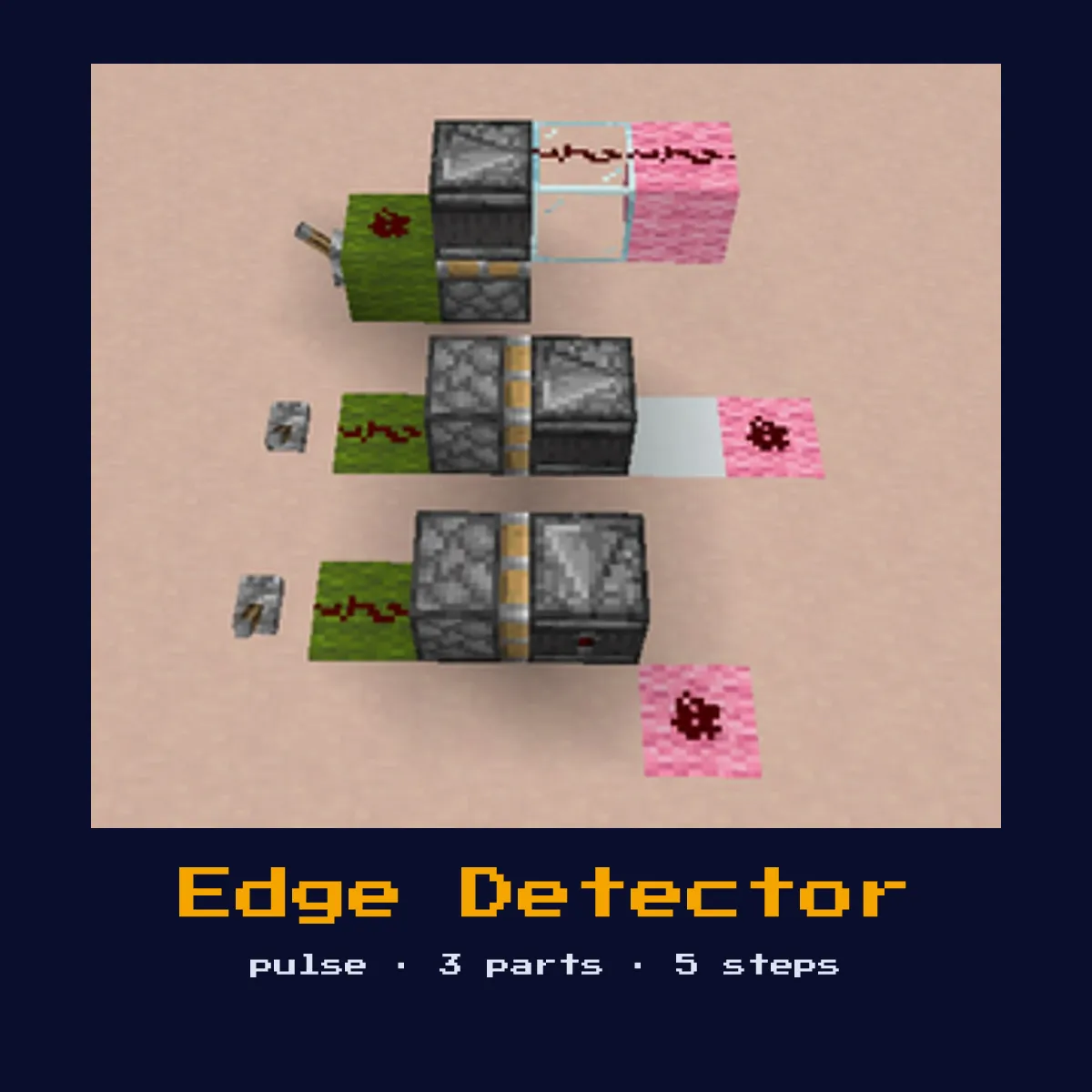
EDGE DETECTOR
Converts a sustained signal into a brief pulse at the moment the signal turns on (rising edge) or off (falling edge). Essential for triggering actions exactly once per state change.

When to Use
One-shot triggers from levers, detecting the exact moment a signal changes, preventing repeated activations.
Materials
 1 Redstone Repeater
 Redstone Dust
- 1 Redstone Comparator or Torch
The material cost of one Edge Detector
Behind the Edge Detector parts list sits 6 crafting ingredients: 3 Stone, 2 Redstone Torch and 1 Redstone.
The Edge Detector leans on Redstone Repeater and Redstone Dust, and every one of them is covered in full on its own component page.
| Part used in Edge Detector | How many per Edge Detector | Crafting cost of a single one |
|---|---|---|
| Redstone Repeater | 1 | 3 Stone, 2 Redstone Torch, 1 Redstone |
The full shopping list for Edge Detector
 3 Stone
 2 Redstone Torch
- 1 Redstone
Prices for Edge Detector are read straight off the recipes in Java Edition 26.2.
What the Edge Detector is, and what it does for you
Converts a sustained signal into a brief pulse at the moment the signal turns on (rising edge) or off (falling edge). Essential for triggering actions exactly once per state change.
As a pulse circuit it reshapes the length or edges of a signal rather than generating one, which is how redstoners tame button presses and observer flashes.
Builders reach for the Edge Detector when what they need is one-shot triggers from levers, detecting the exact moment a signal changes, preventing repeated activations. The whole page is vanilla Java Edition 26.2 throughout.
The Edge Detector explained: timing, logic and parts
It works by racing a signal against a slightly delayed copy of itself: a comparator (or torch) passes power only during the brief window before the delayed path catches up, producing a pulse roughly as long as the repeater delay you set.
You need 1 Redstone Repeater, redstone Dust, and 1 Redstone Comparator or Torch for the Edge Detector, and each of those 3 entries does a job in the circuit that none of the others can take over.
Because this is a pulse-shaping circuit, the thing to watch as you build is the relative timing of the two signal paths, since the output window is the gap between them.
Building the Edge Detector, step by step
- 1Rising edge: Split the input into two paths.
- 2Delay one path with a repeater (1+ ticks).
- 3Feed the delayed path as the side input of a comparator reading the direct path.
- 4The comparator outputs only during the brief moment before the delayed signal arrives.
- 5Falling edge: Invert the input first with a NOT gate, then apply the same technique.
- 6Power it up and watch one full cycle: confirm it produces a pulse of the length you intended before wiring it into a larger contraption.
Uses & applications of the Edge Detector
- ▸One-shot triggers from levers, detecting the exact moment a signal changes, preventing repeated activations.
- ▸Repeater-comparator edge detector (most common), a variant suited to particular space or timing needs.
- ▸Observer-based (observer IS a rising-edge detector), a variant suited to particular space or timing needs.
- ▸Piston-based edge detector (piston breaks dust momentarily), a variant suited to particular space or timing needs.
- ▸Dual-edge detector (pulses on both rising and falling edges), a variant suited to particular space or timing needs.
Tips & common mistakes
- !Set the repeater delay too low and the output pulse is a single tick that fast pistons may miss, give it 2 ticks if a downstream piston must react.
- !Test the output pulse length with a redstone lamp before committing, the lamp's own 2-tick off delay aside, you will see at a glance whether the timing is right.
- !Remember that bare redstone dust loses 1 signal strength per block, so insert a repeater before any run exceeds 15 blocks inside this circuit.
The Edge Detector FAQ, answered

What is an Edge Detector used for?
A Edge Detector is used for one-shot triggers from levers, detecting the exact moment a signal changes, preventing repeated activations. As a pulse circuit it reshapes the length or edges of a signal rather than generating one, which is how redstoners tame button presses and observer flashes.
What do you need to build an Edge Detector?
You need 1 Redstone Repeater, redstone Dust, and 1 Redstone Comparator or Torch. Rising edge: Split the input into two paths.
How does an Edge Detector work?
It works by racing a signal against a slightly delayed copy of itself: a comparator (or torch) passes power only during the brief window before the delayed path catches up, producing a pulse roughly as long as the repeater delay you set.
Are there different versions of the Edge Detector?
Yes, common variants include repeater-comparator edge detector (most common), observer-based (observer IS a rising-edge detector), piston-based edge detector (piston breaks dust momentarily), and dual-edge detector (pulses on both rising and falling edges). Pick the one that fits your available space and timing requirements.
What is the difference between a rising-edge and falling-edge detector?
A rising-edge detector fires a pulse the moment the input switches from off to on. A falling-edge detector fires when the input switches from on to off, built by inverting the input first, then applying the same delayed-comparison trick.
Circuits that share parts with Edge Detector
5 other circuit pages tie straight into Edge Detector, and here is what the link is: