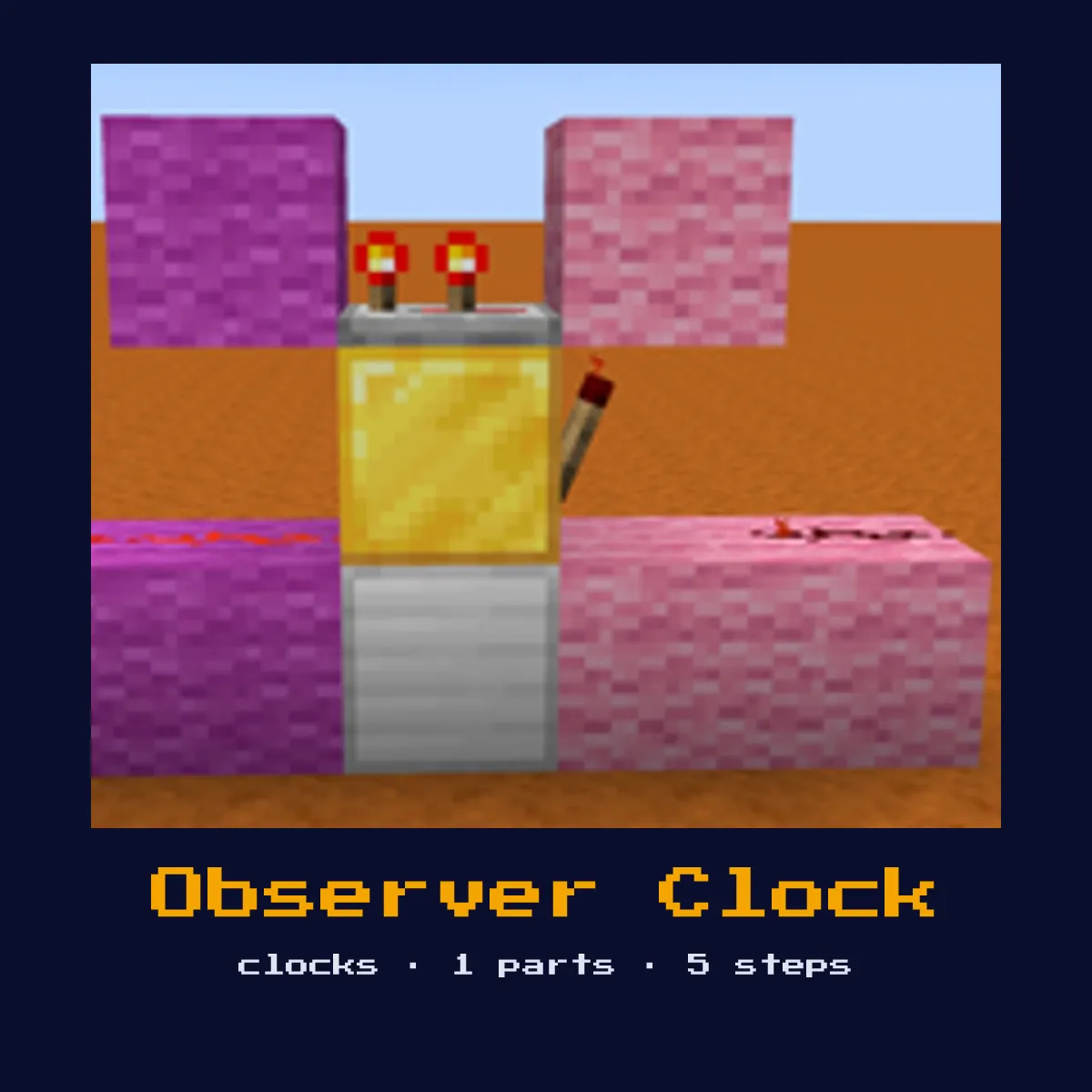
OBSERVER CLOCK
Two observers facing each other create the fastest possible clock. Each observer detects the other's state change, causing infinite rapid toggling at 1 game tick per pulse.

When to Use
Fastest possible clock for rapid-fire dispensers, bubble column activators, zero-tick farms (if applicable).
Materials
What you spend on materials for Observer Clock
The parts list for Observer Clock works out to 18 crafting ingredients once you make everything yourself, led by 12 Cobblestone, 4 Redstone and 2 Quartz.
The Observer Clock leans on Observer, and every one of them is covered in full on its own component page.
| Used in Observer Clock | Amount in a Observer Clock | What one of these costs |
|---|---|---|
 Observer Observer | 2 | 6 Cobblestone, 2 Redstone, 1 Quartz |
Add up a whole Observer Clock in ingredients
 12 Cobblestone
 4 Redstone
 2 Quartz
Recipes behind this Observer Clock table are the ones from Java Edition 26.2.
Start here: what an Observer Clock is and what it does
Two observers facing each other create the fastest possible clock. Each observer detects the other's state change, causing infinite rapid toggling at 1 game tick per pulse.
As a clock it produces a repeating on/off pulse on its own, driving anything that needs to fire at a steady rhythm.
Where you tend to meet it: fastest possible clock for rapid-fire dispensers, bubble column activators, zero-tick farms (if applicable). All 5 of the build steps below are written for vanilla Java Edition 26.2.
The Observer Clock explained: timing, logic and parts
Two observers staring at each other toggle every game tick, producing the fastest clock redstone allows. Each one sees the other's state flip and immediately re-fires, so the loop never settles.
The parts list is short and every single entry on it matters: 2 Observers. Swap one of them out for something else and the Observer Clock stops behaving as it should.
Because this is a clock circuit, the thing to watch as you build is the period, the total tick delay around the loop sets how fast it runs.
How to build the Observer Clock
- 1Place one observer facing any direction.
- 2Place a second observer facing the first one (faces pointing at each other).
- 3They immediately start toggling, each detects the other's state change.
- 4Tap the output from the back of either observer.
- 5Warning: This creates extreme lag if overused. Use sparingly.
- 6Power it up and watch one full cycle: confirm it pulses at the rhythm you expected before wiring it into a larger contraption.
Uses & applications
- ▸Fastest possible clock for rapid-fire dispensers, bubble column activators, zero-tick farms (if applicable).
- ▸Direct 2-observer clock (fastest, 1 game tick), a variant suited to particular space or timing needs.
- ▸Observer + piston clock (slower, more controllable), a variant suited to particular space or timing needs.
- ▸Observer chain clock (sequential observers for timing), a variant suited to particular space or timing needs.
Tips & common mistakes
- !It runs at maximum speed permanently and creates serious server lag if left running, gate it behind a lever and switch it off when idle.
- !If the clock will not be running constantly, add a lever in the loop so you can switch it off and spare the server the block updates.
- !Remember that bare redstone dust loses 1 signal strength per block, so insert a repeater before any run exceeds 15 blocks inside this circuit.
Observer Clock, frequently asked questions

What is an Observer Clock used for?
A Observer Clock is used for fastest possible clock for rapid-fire dispensers, bubble column activators, zero-tick farms (if applicable). As a clock it produces a repeating on/off pulse on its own, driving anything that needs to fire at a steady rhythm.
What do you need to build an Observer Clock?
You need 2 Observers. Place one observer facing any direction.
How does an Observer Clock work?
Two observers staring at each other toggle every game tick, producing the fastest clock redstone allows. Each one sees the other's state flip and immediately re-fires, so the loop never settles.
Are there different versions of the Observer Clock?
Yes, common variants include direct 2-observer clock (fastest, 1 game tick), observer + piston clock (slower, more controllable), and observer chain clock (sequential observers for timing). Pick the one that fits your available space and timing requirements.
Is an observer clock laggy?
Yes. Two observers facing each other toggle every single game tick, which is extremely fast and produces many block updates per second. It is fine for short bursts but will lag a world if many run continuously, so always add an off switch.
Circuits that share parts with Observer Clock
Follow Observer Clock further into the site through these 5 circuit pages: