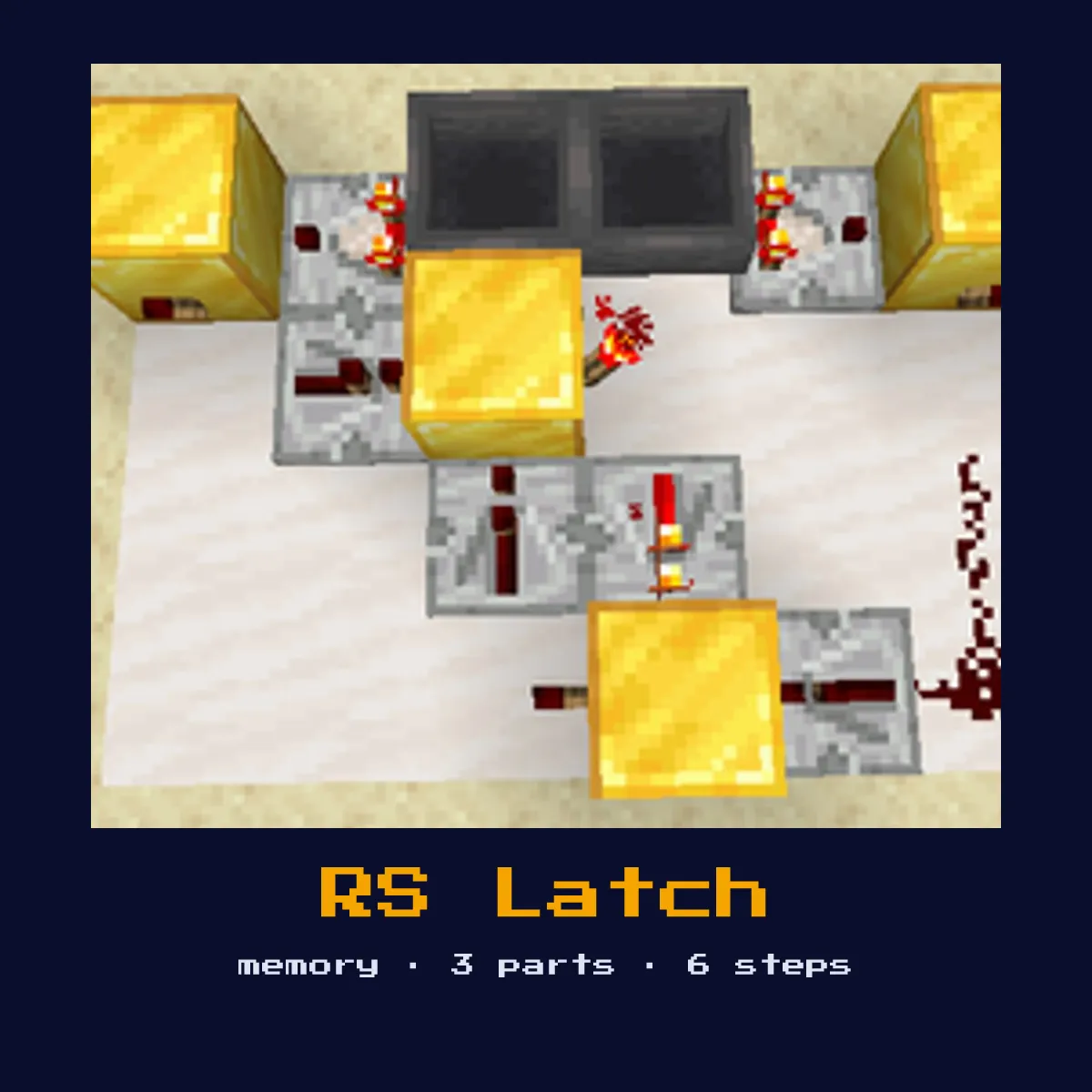
RS LATCH (RS NOR LATCH)
A 1-bit memory cell with Set and Reset inputs. Pulsing Set turns the output ON and it stays ON. Pulsing Reset turns it OFF. The most basic memory circuit in redstone.

When to Use
Toggle doors with two buttons (one open, one close), remembering states, alarm systems that latch on.
Materials
 2 Redstone Torches
- 2 Solid Blocks
 Redstone Dust
RS Latch (RS NOR Latch) materials, and what they cost to craft
Craft every part of a RS Latch (RS NOR Latch) yourself and you spend 4 ingredients, of which 2 Redstone and 2 Stick.
You can read up on Redstone Torch and Redstone Dust separately; those pages carry the delay and power figures this RS Latch (RS NOR Latch) depends on.
| Goes into RS Latch (RS NOR Latch) | Count in one RS Latch (RS NOR Latch) | Price of a single one |
|---|---|---|
| Redstone Torch | 2 | 1 Redstone, 1 Stick |
RS Latch (RS NOR Latch) written out in raw ingredients
- 2 Redstone
 2 Stick
Every RS Latch (RS NOR Latch) figure in this table is read off the Java Edition 26.2 recipes.
What the RS Latch (RS NOR Latch) is, and what it does for you
A 1-bit memory cell with Set and Reset inputs. Pulsing Set turns the output ON and it stays ON. Pulsing Reset turns it OFF. The most basic memory circuit in redstone.
As a memory circuit it stores a state and holds it after the input goes away, giving redstone the equivalent of a saved bit.
The RS Latch (RS NOR Latch) earns its place in toggle doors with two buttons (one open, one close), remembering states, alarm systems that latch on. Everything written on this page is vanilla Java Edition 26.2 behaviour.
What happens inside the RS Latch (RS NOR Latch) when it runs
Two cross-coupled NOR gates store one bit: a pulse on Set turns the output on and it stays on with no further power, a pulse on Reset clears it. The two torches always sit in opposite states, so either side can be read as the stored value.
3 kinds of block go into the RS Latch (RS NOR Latch), and not one of them is there for decoration: 2 Redstone Torches, 2 Solid Blocks, and redstone Dust. Each has a timing or a logic job to do.
Because this is a memory circuit, the thing to watch as you build is the input isolation, stray power on the wrong line can flip or corrupt the stored state.
How to build the RS Latch (RS NOR Latch)
- 1Place two solid blocks with a gap between them.
- 2Place a redstone torch on the inside face of each block (torches facing each other).
- 3Connect each torch's output to the other torch's input block with redstone dust.
- 4Run the Set input into one torch's block, and the Reset input into the other.
- 5Pulsing Set turns off one torch, turning on the other (and vice versa for Reset).
- 6The output is taken from either torch, they always have opposite states.
- 7Power it up and watch one full cycle: confirm it holds its state after you release the input before wiring it into a larger contraption.
Uses & applications
- ▸Toggle doors with two buttons (one open, one close), remembering states, alarm systems that latch on.
- ▸Horizontal RS latch (flat, 2 torches side by side), a variant suited to particular space or timing needs.
- ▸Vertical RS latch (torch tower configuration), a variant suited to particular space or timing needs.
- ▸Repeater-locked RS latch (using locked repeaters for memory), a variant suited to particular space or timing needs.
- ▸Piston RS latch (piston pushes block to break/connect signal), a variant suited to particular space or timing needs.
Tips & common mistakes
- !Pulse Set and Reset at the same instant and the latch enters an undefined race, always keep the two inputs mutually exclusive.
- !Label or colour-code your Set/Reset (or Data/Enable) inputs while building; mixing them up is the usual cause of a latch that will not hold.
- !Remember that bare redstone dust loses 1 signal strength per block, so insert a repeater before any run exceeds 15 blocks inside this circuit.
Questions people ask about the RS Latch (RS NOR Latch)

What is a RS Latch (RS NOR Latch) used for?
A RS Latch (RS NOR Latch) is used for toggle doors with two buttons (one open, one close), remembering states, alarm systems that latch on. As a memory circuit it stores a state and holds it after the input goes away, giving redstone the equivalent of a saved bit.
What do you need to build a RS Latch (RS NOR Latch)?
You need 2 Redstone Torches, 2 Solid Blocks, and redstone Dust. Place two solid blocks with a gap between them.
How does a RS Latch (RS NOR Latch) work?
Two cross-coupled NOR gates store one bit: a pulse on Set turns the output on and it stays on with no further power, a pulse on Reset clears it. The two torches always sit in opposite states, so either side can be read as the stored value.

Are there different versions of the RS Latch (RS NOR Latch)?
Yes, common variants include horizontal RS latch (flat, 2 torches side by side), vertical RS latch (torch tower configuration), repeater-locked RS latch (using locked repeaters for memory), and piston RS latch (piston pushes block to break/connect signal). Pick the one that fits your available space and timing requirements.

How does an RS latch remember a bit without power?
The two NOR gates feed each other: whichever torch is off holds the other on, and that state is self-sustaining. Once Set or Reset has flipped it, the latch keeps its value indefinitely with no input, which is what makes it a 1-bit memory cell.
Circuits that share parts with RS Latch (RS NOR Latch)
RS Latch (RS NOR Latch) does not stand on its own. 5 other circuit pages are tied to it: