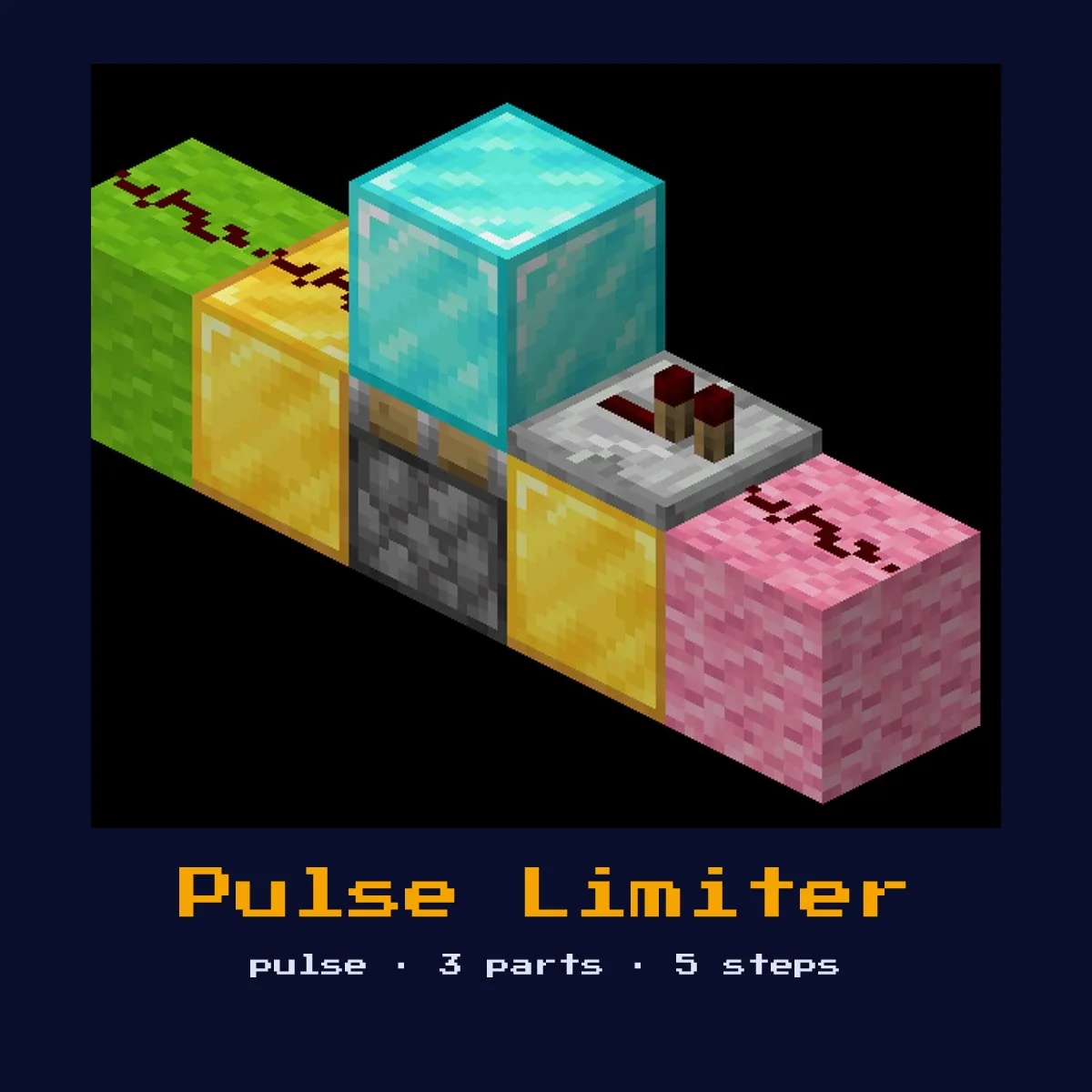
PULSE LIMITER (SHORTENER)
Takes a long input signal and shortens it to a specific pulse length. Useful for converting lever toggles into brief pulses or limiting piston extension time.

When to Use
Converting toggle switches to momentary pulses, preventing piston doors from staying open, timing-critical circuits.
Materials
 1-2 Redstone Repeaters
 Redstone Dust
- 1 Redstone Comparator or Torch
The material cost of one Pulse Limiter (Shortener)
Adding up the recipes behind those parts, one Pulse Limiter (Shortener) costs 6 crafting ingredients in total: 3 Stone, 2 Redstone Torch and 1 Redstone.
You can read up on Redstone Repeater and Redstone Dust separately; those pages carry the delay and power figures this Pulse Limiter (Shortener) depends on.
| Part used in Pulse Limiter (Shortener) | How many per Pulse Limiter (Shortener) | Crafting cost of a single one |
|---|---|---|
| Redstone Repeater | 1 or more | 3 Stone, 2 Redstone Torch, 1 Redstone |
The full shopping list for Pulse Limiter (Shortener)
 3 Stone
 2 Redstone Torch
- 1 Redstone
Prices for Pulse Limiter (Shortener) are read straight off the recipes in Java Edition 26.2.
Overview: what the Pulse Limiter (Shortener) is and does
Takes a long input signal and shortens it to a specific pulse length. Useful for converting lever toggles into brief pulses or limiting piston extension time.
As a pulse circuit it reshapes the length or edges of a signal rather than generating one, which is how redstoners tame button presses and observer flashes.
In practice it is used for converting toggle switches to momentary pulses, preventing piston doors from staying open, timing-critical circuits. The build below targets vanilla Java Edition 26.2.
What happens inside the Pulse Limiter (Shortener) when it runs
It ANDs the input against a delayed, inverted copy of itself, so the output is high only during the short window before the inverted path arrives, turning even a held lever into a fixed-length pulse you set with the repeater delay.
It is assembled from 1-2 Redstone Repeaters, redstone Dust, and 1 Redstone Comparator or Torch, and each of those 3 parts plays a specific timing or logic role rather than being interchangeable filler.
Because this is a pulse-shaping circuit, the thing to watch as you build is the relative timing of the two signal paths, since the output window is the gap between them.
How to lay out a Pulse Limiter (Shortener)
- 1Split the input into two paths.
- 2One path goes directly to one input of an AND gate.
- 3The other path goes through a delay (repeaters), then through a NOT gate, then to the other AND input.
- 4The output is only ON during the window before the delayed-inverted signal arrives.
- 5Adjust the repeater delay to set the output pulse length.
- 6Power it up and watch one full cycle: confirm it produces a pulse of the length you intended before wiring it into a larger contraption.
Jobs the Pulse Limiter (Shortener) does well
- ▸Converting toggle switches to momentary pulses, preventing piston doors from staying open, timing-critical circuits.
- ▸Repeater + comparator limiter (precise timing), a variant suited to particular space or timing needs.
- ▸Torch-based pulse shortener (1-tick pulses), a variant suited to particular space or timing needs.
- ▸Piston cutoff (piston physically breaks signal after delay), a variant suited to particular space or timing needs.
Tips & common mistakes
- !If your input is shorter than the limiter window the output just matches the input, so size the repeater delay below your shortest expected input.
- !Test the output pulse length with a redstone lamp before committing, the lamp's own 2-tick off delay aside, you will see at a glance whether the timing is right.
- !Remember that bare redstone dust loses 1 signal strength per block, so insert a repeater before any run exceeds 15 blocks inside this circuit.
Pulse Limiter (Shortener) FAQ

What is a Pulse Limiter (Shortener) used for?
A Pulse Limiter (Shortener) is used for converting toggle switches to momentary pulses, preventing piston doors from staying open, timing-critical circuits. As a pulse circuit it reshapes the length or edges of a signal rather than generating one, which is how redstoners tame button presses and observer flashes.
What do you need to build a Pulse Limiter (Shortener)?
You need 1-2 Redstone Repeaters, redstone Dust, and 1 Redstone Comparator or Torch. Split the input into two paths.

How does a Pulse Limiter (Shortener) work?
It ANDs the input against a delayed, inverted copy of itself, so the output is high only during the short window before the inverted path arrives, turning even a held lever into a fixed-length pulse you set with the repeater delay.

Are there different versions of the Pulse Limiter (Shortener)?
Yes, common variants include repeater + comparator limiter (precise timing), torch-based pulse shortener (1-tick pulses), and piston cutoff (piston physically breaks signal after delay). Pick the one that fits your available space and timing requirements.
Circuits that share parts with Pulse Limiter (Shortener)
5 other circuit pages tie straight into Pulse Limiter (Shortener), and here is what the link is: