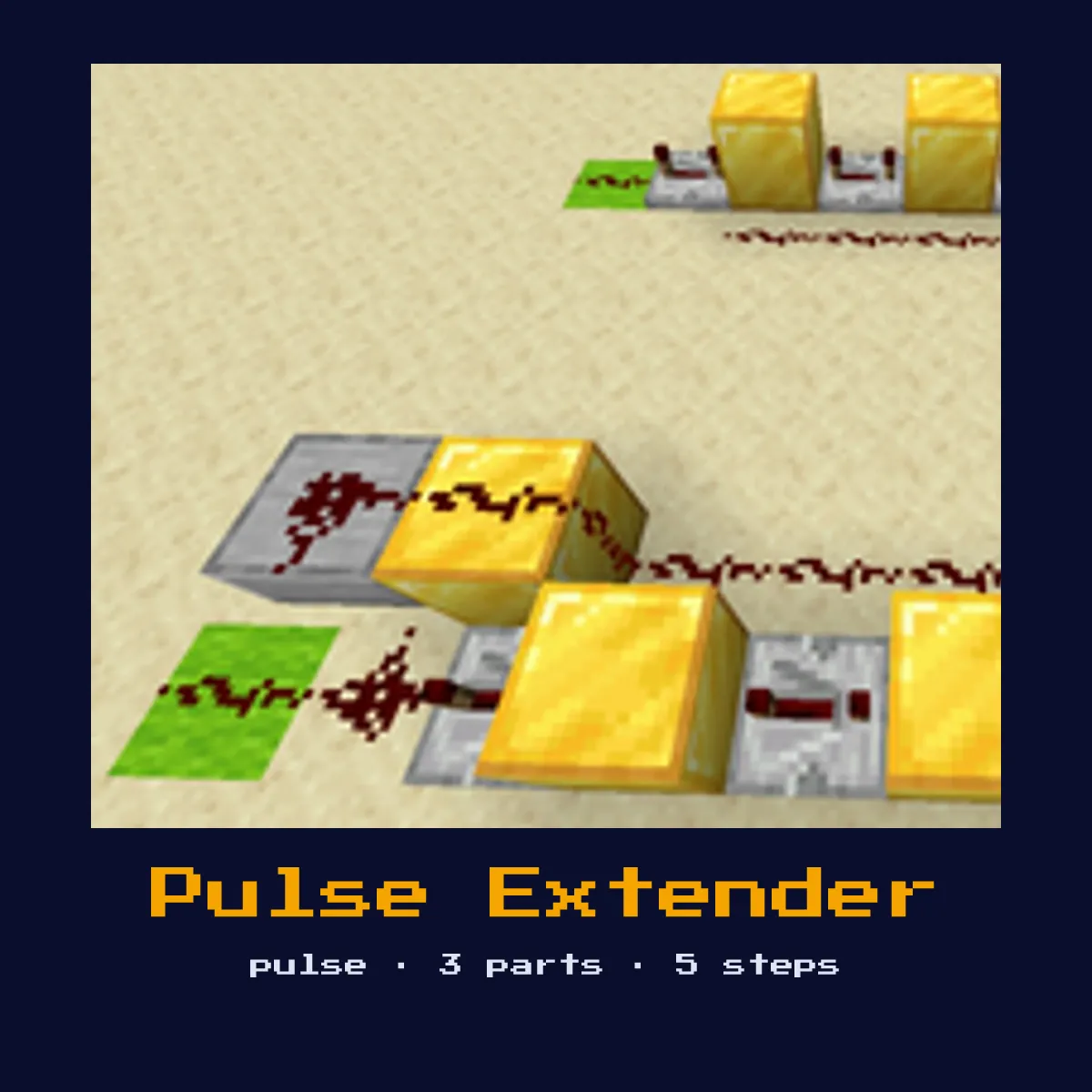
PULSE EXTENDER
Takes a short input pulse and extends it to a longer output duration. Uses repeater chains, comparator loops, or sticky pistons to hold the signal for a set time.

When to Use
Making button presses last longer, keeping doors open for a set time, extending observer pulses for slower circuits.
Materials
 Multiple Redstone Repeaters
 Redstone Dust
- Solid blocks
The material cost of one Pulse Extender
A Pulse Extender scales with how many parts you chain, and each one has its own price: one Redstone Repeater costs 3 Stone, 2 Redstone Torch and 1 Redstone.
| Part used in Pulse Extender | How many per Pulse Extender | Crafting cost of a single one |
|---|---|---|
| Redstone Repeater | as many as the build needs | 3 Stone, 2 Redstone Torch, 1 Redstone |
Prices for Pulse Extender are read straight off the recipes in Java Edition 26.2.
Pulse Extender, in one place: what it is and what it does
Takes a short input pulse and extends it to a longer output duration. Uses repeater chains, comparator loops, or sticky pistons to hold the signal for a set time.
As a pulse circuit it reshapes the length or edges of a signal rather than generating one, which is how redstoners tame button presses and observer flashes.
Builders reach for the Pulse Extender when what they need is making button presses last longer, keeping doors open for a set time, extending observer pulses for slower circuits. The whole page is vanilla Java Edition 26.2 throughout.
The Pulse Extender explained: timing, logic and parts
Chained repeaters hold the output high for the original pulse plus the sum of their delays, while the sticky-piston-and-redstone-block variant latches power until the piston retracts, allowing far longer extensions of several seconds.
You need multiple Redstone Repeaters, redstone Dust, and solid blocks for the Pulse Extender, and each of those 3 entries does a job in the circuit that none of the others can take over.
Because this is a pulse-shaping circuit, the thing to watch as you build is the relative timing of the two signal paths, since the output window is the gap between them.
How to build the Pulse Extender
- 1Simple method: Chain repeaters in series from the input to the output.
- 2Each repeater adds 1-4 ticks of delay.
- 3The output stays on for the original pulse length PLUS all repeater delays.
- 4For very long extensions, use a sticky piston holding a redstone block.
- 5The piston extends on the pulse, and the redstone block keeps the circuit powered until the piston retracts.
- 6Power it up and watch one full cycle: confirm it produces a pulse of the length you intended before wiring it into a larger contraption.
Uses & applications of the Pulse Extender
- ▸Making button presses last longer, keeping doors open for a set time, extending observer pulses for slower circuits.
- ▸Repeater chain (adds fixed delay, easy to adjust), a variant suited to particular space or timing needs.
- ▸Sticky piston + redstone block (long extensions), a variant suited to particular space or timing needs.
- ▸RS latch with delayed reset (toggle on, auto-off after delay), a variant suited to particular space or timing needs.
- ▸Comparator fade-out (signal strength gradually decreases), a variant suited to particular space or timing needs.
Tips & common mistakes
- !Repeater chains only stretch a pulse by up to 4 ticks each, so for multi-second holds switch to the piston-block method rather than placing dozens of repeaters.
- !Test the output pulse length with a redstone lamp before committing, the lamp's own 2-tick off delay aside, you will see at a glance whether the timing is right.
- !Remember that bare redstone dust loses 1 signal strength per block, so insert a repeater before any run exceeds 15 blocks inside this circuit.
The Pulse Extender FAQ, answered

What is a Pulse Extender used for?
A Pulse Extender is used for making button presses last longer, keeping doors open for a set time, extending observer pulses for slower circuits. As a pulse circuit it reshapes the length or edges of a signal rather than generating one, which is how redstoners tame button presses and observer flashes.
What do you need to build a Pulse Extender?
You need multiple Redstone Repeaters, redstone Dust, and solid blocks. Simple method: Chain repeaters in series from the input to the output.

How does a Pulse Extender work?
Chained repeaters hold the output high for the original pulse plus the sum of their delays, while the sticky-piston-and-redstone-block variant latches power until the piston retracts, allowing far longer extensions of several seconds.

Are there different versions of the Pulse Extender?
Yes, common variants include repeater chain (adds fixed delay, easy to adjust), sticky piston + redstone block (long extensions), RS latch with delayed reset (toggle on, auto-off after delay), and comparator fade-out (signal strength gradually decreases). Pick the one that fits your available space and timing requirements.
Circuits that share parts with Pulse Extender
Follow Pulse Extender further into the site through these 5 circuit pages: