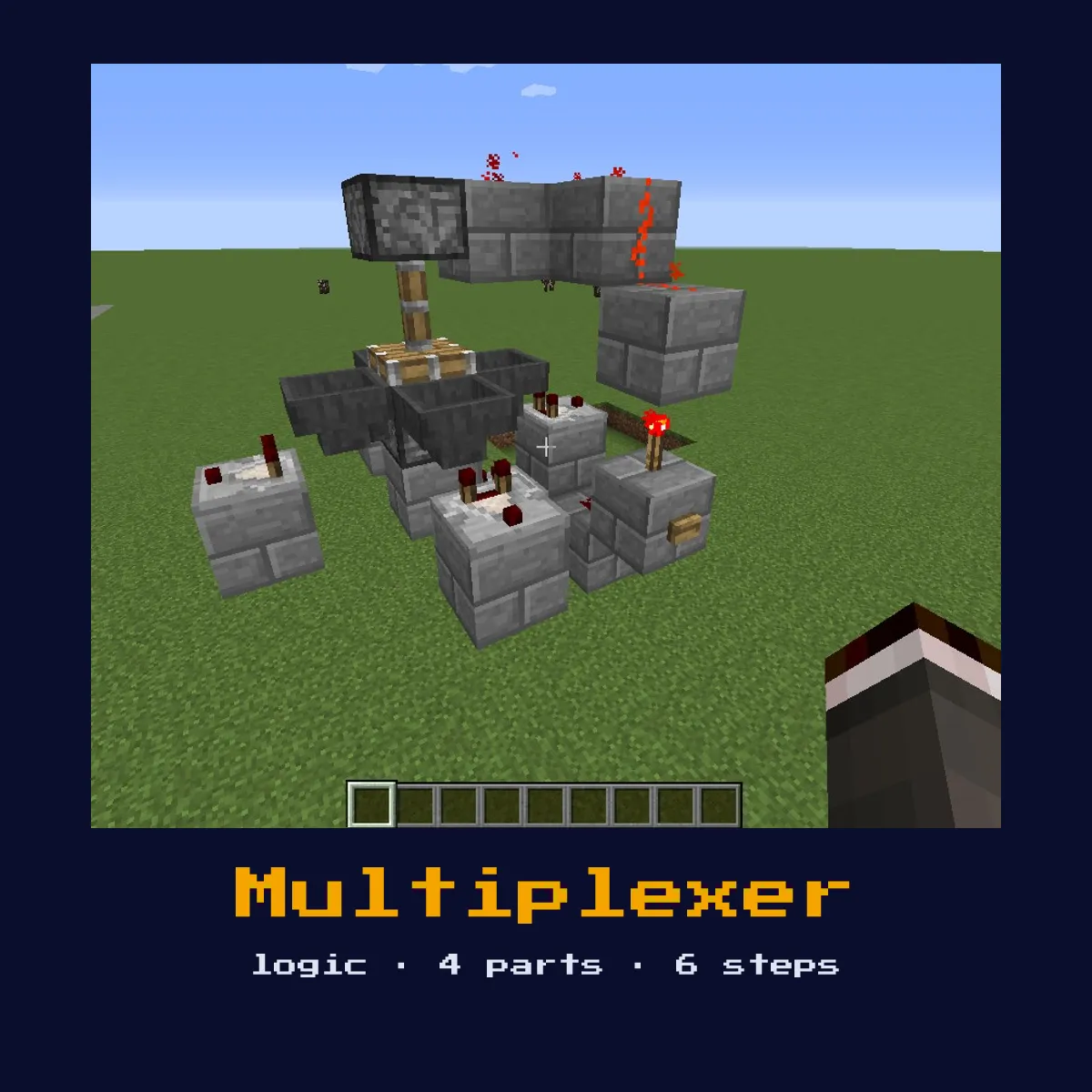
MULTIPLEXER (MUX)
Selects one of several input signals and routes it to a single output, based on a select signal. A 2-to-1 MUX has 2 data inputs and 1 select line. Essential for bus routing.

When to Use
Signal routing, data bus selection, programmable circuits, ALU input selection, display multiplexing.
Materials
 2+ Redstone Repeaters
- AND gate components
- OR gate components
- NOT gate components
What you spend on materials for Multiplexer (MUX)
Behind the Multiplexer (MUX) parts list sits 12 crafting ingredients: 6 Stone, 4 Redstone Torch and 2 Redstone.
You can read up on Redstone Repeater separately; those pages carry the delay and power figures this Multiplexer (MUX) depends on.
| Used in Multiplexer (MUX) | Amount in a Multiplexer (MUX) | What one of these costs |
|---|---|---|
| Redstone Repeater | 2 or more | 3 Stone, 2 Redstone Torch, 1 Redstone |
Add up a whole Multiplexer (MUX) in ingredients
 6 Stone
 4 Redstone Torch
 2 Redstone
Recipes behind this Multiplexer (MUX) table are the ones from Java Edition 26.2.
Overview: what the Multiplexer (MUX) is and does
Selects one of several input signals and routes it to a single output, based on a select signal. A 2-to-1 MUX has 2 data inputs and 1 select line. Essential for bus routing.
As a logic circuit it routes, counts, or decodes signals, forming the building blocks that scale up into redstone computers.
Builders reach for the Multiplexer (MUX) when what they need is signal routing, data bus selection, programmable circuits, ALU input selection, display multiplexing. The whole page is vanilla Java Edition 26.2 throughout.
How the Multiplexer (MUX) works: the redstone mechanics
A 2-to-1 MUX gates input A with the select signal S and input B with NOT S, then ORs the two together, so the output equals A when S is on and B when S is off. Stacking MUX stages builds 4-to-1, 8-to-1, and wider selectors for data buses.
You need 2+ Redstone Repeaters, AND gate components, OR gate components, and NOT gate components for the Multiplexer (MUX), and each of those 4 entries does a job in the circuit that none of the others can take over.
Because this is a logic circuit, the thing to watch as you build is signal isolation between stages, so one part of the logic does not back-feed into another.
How to build the Multiplexer (MUX)
- 1For a 2-to-1 MUX: create a select signal S and its inverse NOT S.
- 2AND input A with S (A passes when S is ON).
- 3AND input B with NOT S (B passes when S is OFF).
- 4OR the two AND outputs together to get the final output.
- 5When S=1, output=A. When S=0, output=B.
- 6Chain MUXes for more inputs (4-to-1, 8-to-1, etc.).
- 7Power it up and watch one full cycle: confirm it drives the correct output for each input combination before wiring it into a larger contraption.
Jobs the Multiplexer (MUX) does well
- ▸Signal routing, data bus selection, programmable circuits, ALU input selection, display multiplexing.
- ▸2-to-1 MUX (basic, 1 select line), a variant suited to particular space or timing needs.
- ▸4-to-1 MUX (2 select lines, 4 data inputs), a variant suited to particular space or timing needs.
- ▸Analog MUX (routes signal strength values using comparators), a variant suited to particular space or timing needs.
- ▸Piston-based MUX (physically connects/disconnects signal paths), a variant suited to particular space or timing needs.
Tips & common mistakes
- !Generate NOT S from the same S source rather than a separate switch, or the two select halves can briefly overlap and leak both inputs.
- !Build and verify each logic stage on its own before connecting them; debugging a full multi-stage circuit at once is far harder.
- !Remember that bare redstone dust loses 1 signal strength per block, so insert a repeater before any run exceeds 15 blocks inside this circuit.
Multiplexer (MUX) FAQ: the questions people ask

What is a Multiplexer (MUX) used for?
A Multiplexer (MUX) is used for signal routing, data bus selection, programmable circuits, ALU input selection, display multiplexing. As a logic circuit it routes, counts, or decodes signals, forming the building blocks that scale up into redstone computers.
What do you need to build a Multiplexer (MUX)?
You need 2+ Redstone Repeaters, AND gate components, OR gate components, and NOT gate components. For a 2-to-1 MUX: create a select signal S and its inverse NOT S.

How does a Multiplexer (MUX) work?
A 2-to-1 MUX gates input A with the select signal S and input B with NOT S, then ORs the two together, so the output equals A when S is on and B when S is off. Stacking MUX stages builds 4-to-1, 8-to-1, and wider selectors for data buses.

Are there different versions of the Multiplexer (MUX)?
Yes, common variants include 2-to-1 MUX (basic, 1 select line), 4-to-1 MUX (2 select lines, 4 data inputs), analog MUX (routes signal strength values using comparators), and piston-based MUX (physically connects/disconnects signal paths). Pick the one that fits your available space and timing requirements.
Circuits that share parts with Multiplexer (MUX)
Follow Multiplexer (MUX) further into the site through these 5 circuit pages: