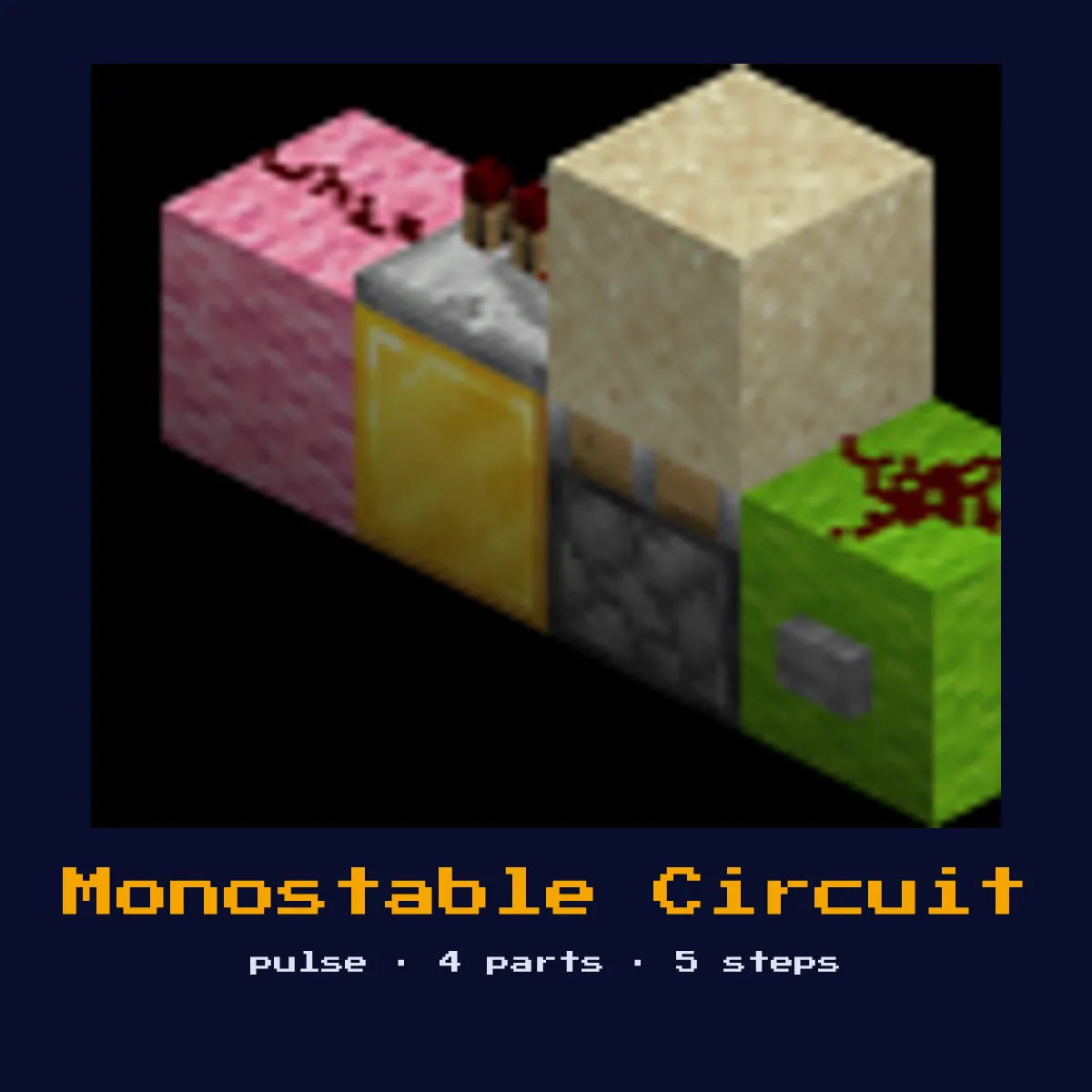
MONOSTABLE CIRCUIT
Produces exactly one output pulse of a fixed duration regardless of how long the input is held. Combines pulse limiting and edge detection for reliable single-shot behavior.

When to Use
Ensuring exactly one dispenser shot per button press, reliable T flip-flop input, debouncing noisy signals.
Materials
The material cost of one Monostable Circuit
The parts list for Monostable Circuit works out to 13 crafting ingredients once you make everything yourself, led by 6 Stone, 5 Redstone Torch and 1 Quartz, with 1 other kind behind them.
The Monostable Circuit leans on Redstone Repeater, Redstone Comparator and Redstone Dust, and every one of them is covered in full on its own component page.
| Part used in Monostable Circuit | How many per Monostable Circuit | Crafting cost of a single one |
|---|---|---|
 Redstone Repeater Redstone Repeater | 1 | 3 Stone, 2 Redstone Torch, 1 Redstone |
 Redstone Comparator Redstone Comparator | 1 | 3 Redstone Torch, 3 Stone, 1 Quartz |
The full shopping list for Monostable Circuit
 6 Stone
 5 Redstone Torch
 1 Quartz
 1 Redstone
Prices for Monostable Circuit are read straight off the recipes in Java Edition 26.2.
What the Monostable Circuit is, and what it does for you
Produces exactly one output pulse of a fixed duration regardless of how long the input is held. Combines pulse limiting and edge detection for reliable single-shot behavior.
As a pulse circuit it reshapes the length or edges of a signal rather than generating one, which is how redstoners tame button presses and observer flashes.
Where you tend to meet it: ensuring exactly one dispenser shot per button press, reliable T flip-flop input, debouncing noisy signals. All 5 of the build steps below are written for vanilla Java Edition 26.2.
What happens inside the Monostable Circuit when it runs
It combines edge detection with pulse limiting so that one rising edge produces exactly one output pulse of fixed length, no matter how long the input is held. The feedback loop blocks re-triggering until the input fully resets.
The parts list is short and every single entry on it matters: 1 Redstone Repeater, 1 Redstone Comparator, redstone Dust, and solid blocks. Swap one of them out for something else and the Monostable Circuit stops behaving as it should.
Because this is a pulse-shaping circuit, the thing to watch as you build is the relative timing of the two signal paths, since the output window is the gap between them.
How to build the Monostable Circuit
- 1Run input through a repeater set to 1 tick.
- 2Split the repeater output: one path to the circuit output, one path looping to a comparator side input.
- 3The comparator compares the direct input (back) against the delayed loop (side).
- 4On the rising edge of the input, the output fires for exactly the repeater delay duration.
- 5The feedback loop prevents re-triggering until the input fully resets.
- 6Power it up and watch one full cycle: confirm it produces a pulse of the length you intended before wiring it into a larger contraption.
Uses & applications of the Monostable Circuit
- ▸Ensuring exactly one dispenser shot per button press, reliable T flip-flop input, debouncing noisy signals.
- ▸Comparator monostable (most compact), a variant suited to particular space or timing needs.
- ▸Piston monostable (mechanical, very reliable), a variant suited to particular space or timing needs.
- ▸Dropper-based monostable (item-count dependent), a variant suited to particular space or timing needs.
Tips & common mistakes
- !It is the right tool when a button held down must still fire only once, a plain wire would let the dispenser or piston act for the whole hold.
- !Test the output pulse length with a redstone lamp before committing, the lamp's own 2-tick off delay aside, you will see at a glance whether the timing is right.
- !Remember that bare redstone dust loses 1 signal strength per block, so insert a repeater before any run exceeds 15 blocks inside this circuit.
The Monostable Circuit FAQ, answered

What is a Monostable Circuit used for?
A Monostable Circuit is used for ensuring exactly one dispenser shot per button press, reliable T flip-flop input, debouncing noisy signals. As a pulse circuit it reshapes the length or edges of a signal rather than generating one, which is how redstoners tame button presses and observer flashes.
What do you need to build a Monostable Circuit?
You need 1 Redstone Repeater, 1 Redstone Comparator, redstone Dust, and solid blocks. Run input through a repeater set to 1 tick.

How does a Monostable Circuit work?
It combines edge detection with pulse limiting so that one rising edge produces exactly one output pulse of fixed length, no matter how long the input is held. The feedback loop blocks re-triggering until the input fully resets.

Are there different versions of the Monostable Circuit?
Yes, common variants include comparator monostable (most compact), piston monostable (mechanical, very reliable), and dropper-based monostable (item-count dependent). Pick the one that fits your available space and timing requirements.
Circuits that share parts with Monostable Circuit
Follow Monostable Circuit further into the site through these 5 circuit pages: