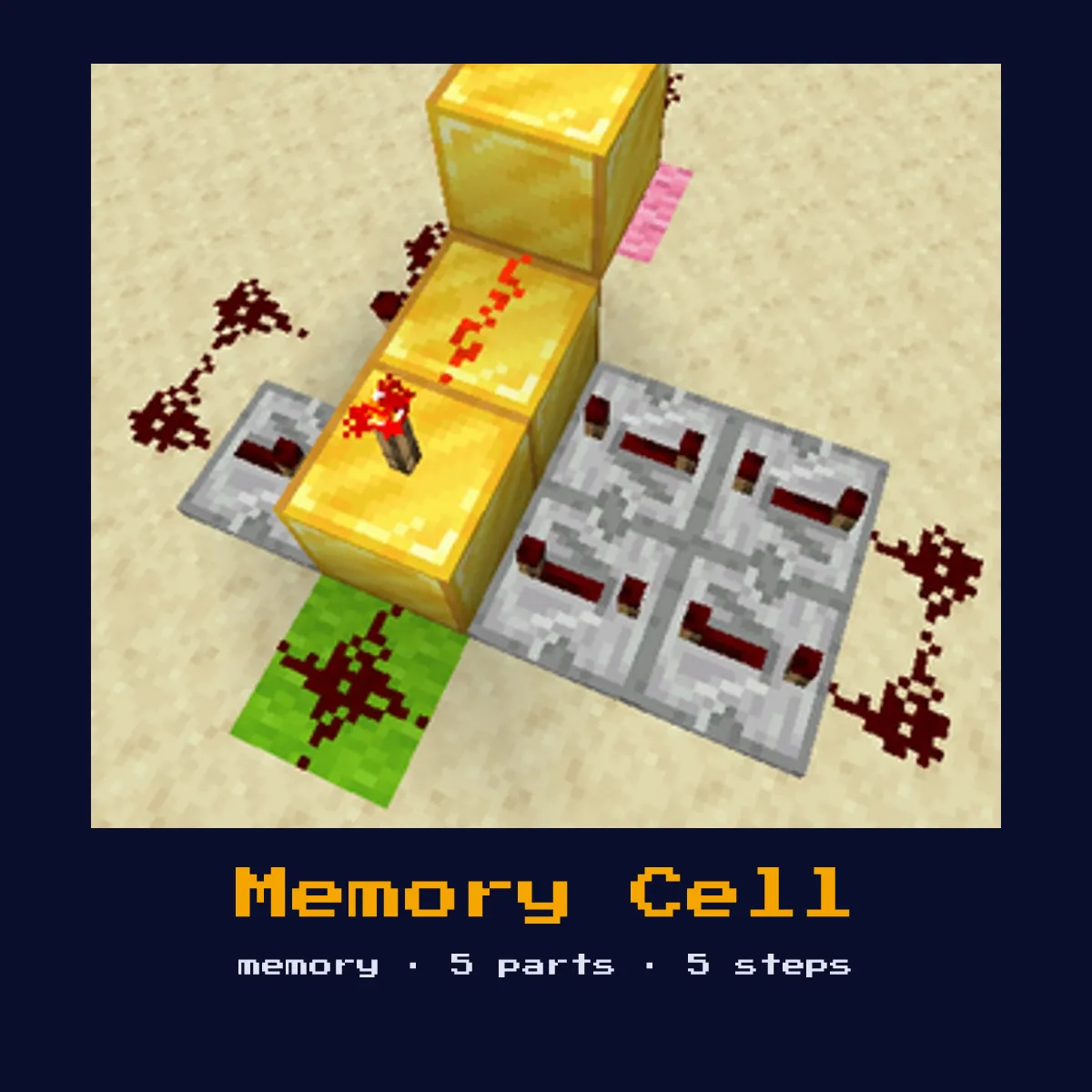
MEMORY CELL (ADDRESSABLE)
A circuit that stores a value and can be written to or read from using address/control signals. Multiple cells form a register or RAM. Foundation for redstone computers.

When to Use
Redstone computers, programmable combination locks, stored password systems, ROM data storage.
Materials
The material cost of one Memory Cell (Addressable)
A Memory Cell (Addressable) scales with how many parts you chain, and each one has its own price: one Redstone Torch costs 1 Redstone and 1 Stick, one Redstone Repeater costs 3 Stone, 2 Redstone Torch and 1 Redstone, one Redstone Comparator costs 3 Redstone Torch, 3 Stone and 1 Quartz and one Lever costs 1 Cobblestone and 1 Stick.
| Part used in Memory Cell (Addressable) | How many per Memory Cell (Addressable) | Crafting cost of a single one |
|---|---|---|
 Redstone Torch Redstone Torch | as many as the build needs | 1 Redstone, 1 Stick |
 Redstone Repeater Redstone Repeater | as many as the build needs | 3 Stone, 2 Redstone Torch, 1 Redstone |
 Redstone Comparator Redstone Comparator | as many as the build needs | 3 Redstone Torch, 3 Stone, 1 Quartz |
 Lever Lever | as many as the build needs | 1 Cobblestone, 1 Stick |
Prices for Memory Cell (Addressable) are read straight off the recipes in Java Edition 26.2.
What the Memory Cell (Addressable) is, and what it does for you
A circuit that stores a value and can be written to or read from using address/control signals. Multiple cells form a register or RAM. Foundation for redstone computers.
As a memory circuit it stores a state and holds it after the input goes away, giving redstone the equivalent of a saved bit.
In practice it is used for redstone computers, programmable combination locks, stored password systems, ROM data storage. The build below targets vanilla Java Edition 26.2.
The Memory Cell (Addressable) explained: timing, logic and parts
A row of RS latches or locked repeaters stores one bit each, gated by a shared Write Enable line for storing and a Read Enable line for reading onto an output bus. Addressing several cells through a decoder is how redstone RAM and ROM are built.
It is assembled from multiple Redstone Torches, repeaters, comparators, levers, and solid Blocks, and each of those 5 parts plays a specific timing or logic role rather than being interchangeable filler.
Because this is a memory circuit, the thing to watch as you build is the input isolation, stray power on the wrong line can flip or corrupt the stored state.
How to build the Memory Cell (Addressable)
- 1Build a row of RS latches or locked repeaters (one per bit).
- 2Add a Write Enable line that gates all data inputs simultaneously.
- 3Add a Read Enable line that passes the stored values to the output bus.
- 4For addressing: use a decoder to select which cell to read/write.
- 5For ROM: use torch patterns on blocks where torch=1, no torch=0.
- 6Power it up and watch one full cycle: confirm it holds its state after you release the input before wiring it into a larger contraption.
Uses & applications
- ▸Redstone computers, programmable combination locks, stored password systems, ROM data storage.
- ▸RS latch array (one RS latch per bit, simple but large), a variant suited to particular space or timing needs.
- ▸Locked repeater memory (compact, uses repeater lock feature), a variant suited to particular space or timing needs.
- ▸Comparator memory (analog, stores signal strengths 0-15), a variant suited to particular space or timing needs.
- ▸ROM (read-only, torch pattern encodes fixed data), a variant suited to particular space or timing needs.
Tips & common mistakes
- !Without separate write and read enables a cell will corrupt as you read it, keep the two control lines distinct.
- !Label or colour-code your Set/Reset (or Data/Enable) inputs while building; mixing them up is the usual cause of a latch that will not hold.
- !Remember that bare redstone dust loses 1 signal strength per block, so insert a repeater before any run exceeds 15 blocks inside this circuit.
Memory Cell (Addressable) FAQ

What is a Memory Cell (Addressable) used for?
A Memory Cell (Addressable) is used for redstone computers, programmable combination locks, stored password systems, ROM data storage. As a memory circuit it stores a state and holds it after the input goes away, giving redstone the equivalent of a saved bit.
What do you need to build a Memory Cell (Addressable)?
You need multiple Redstone Torches, repeaters, comparators, levers, and solid Blocks. Build a row of RS latches or locked repeaters (one per bit).

How does a Memory Cell (Addressable) work?
A row of RS latches or locked repeaters stores one bit each, gated by a shared Write Enable line for storing and a Read Enable line for reading onto an output bus. Addressing several cells through a decoder is how redstone RAM and ROM are built.

Are there different versions of the Memory Cell (Addressable)?
Yes, common variants include RS latch array (one RS latch per bit, simple but large), locked repeater memory (compact, uses repeater lock feature), comparator memory (analog, stores signal strengths 0-15), and ROM (read-only, torch pattern encodes fixed data). Pick the one that fits your available space and timing requirements.
Circuits that share parts with Memory Cell (Addressable)
5 other circuit pages tie straight into Memory Cell (Addressable), and here is what the link is: