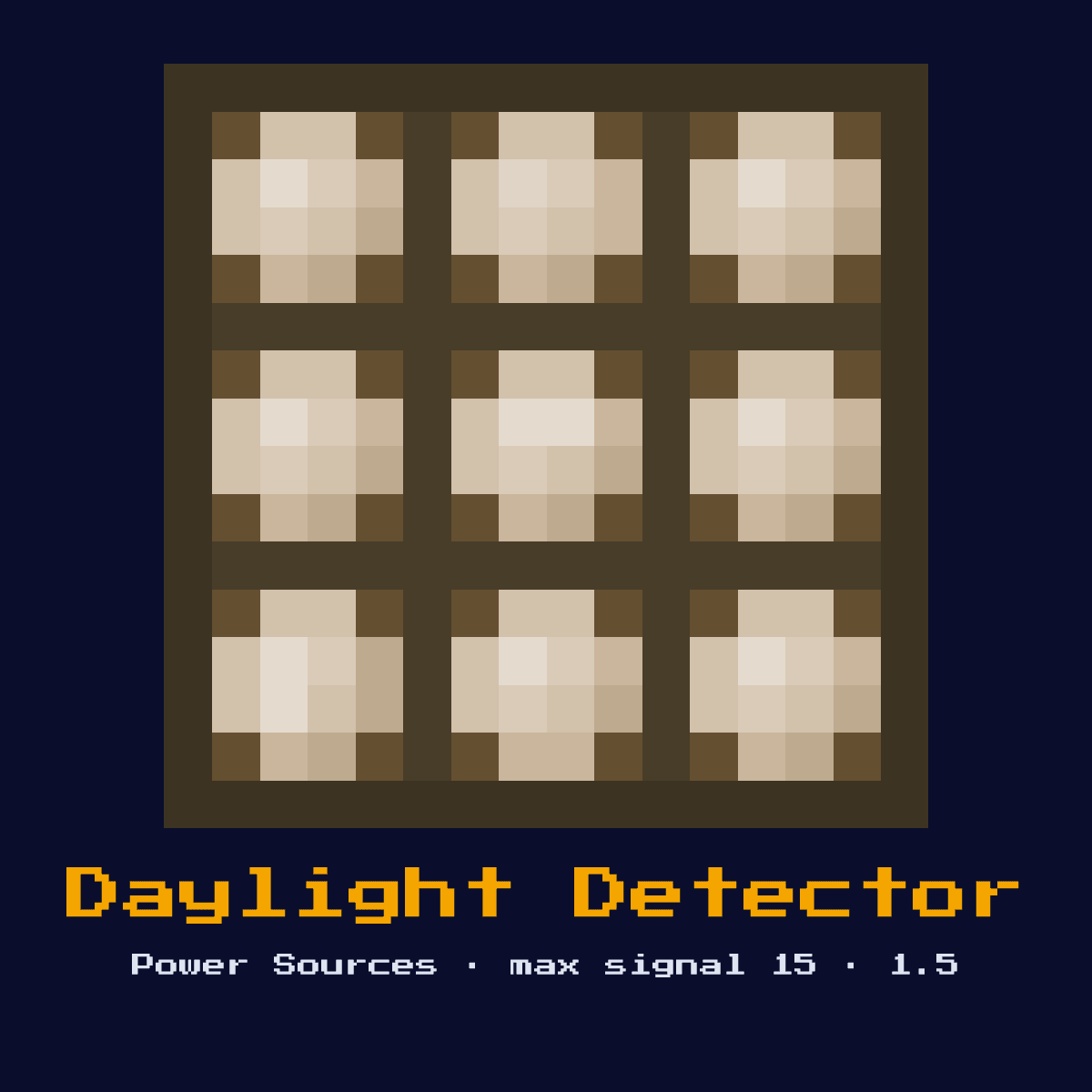
DAYLIGHT DETECTOR
Outputs a redstone signal proportional to the current sunlight level. Can be inverted (right-click) to output based on darkness. Signal ranges from 0 to 15 depending on time of day.

Crafting Recipe
3 Glass + 3 Nether Quartz + 3 Wooden Slabs → 1 Daylight Detector
Signal Behavior
Input
Sunlight level (sky light - block obstructions)
Output
 Output
0-15 based on sun position (inverted: moon position)
Max Signal Strength
15
Delay
 Delay
DelayReal-time (updates with sun position)
Modes
- Daylight mode
- Inverted (nighttime) mode
Making Daylight Detector: the pattern and the full ingredient count
To craft Daylight Detector you place 3 Glass, 3 Quartz and 3 Wooden Slabs in the shape below, which fills a 3x3 corner of the grid. That is 9 items for a single Daylight Detector.
Most of that is Glass: 3 of the 9 squares, so stock up on that before you start on Daylight Detector. Whatever wooden slabs you have works here, so Daylight Detector never blocks on one specific wood.
Daylight Detector in a 3x3 grid, square by square


| Ingredient in Daylight Detector | Number of squares |
|---|---|
| Glass | 3 |
| Quartz | 3 |
| Wooden Slabs (any variant) | 3 |
| Daylight Detector out of a single craft | 1 |
As the Daylight Detector crafting recipe stands in Java Edition 26.2.
The Daylight Detector in short: what it is and what it does
Outputs a redstone signal proportional to the current sunlight level. Can be inverted (right-click) to output based on darkness. Signal ranges from 0 to 15 depending on time of day.
As a power source it sits at the start of a circuit, generating the signal that everything downstream reacts to. It is the only block that reads the sky directly, making it the backbone of automatic lighting and solar day/night clocks.
Minecraft 1.5 brought the Daylight Detector in. What follows is how it behaves in Java Edition 26.2.
Inside the Daylight Detector: what the signal actually does
What the Daylight Detector reads: sunlight level (sky light - block obstructions). What it gives back: 0-15 based on sun position (inverted: moon position).
In daylight mode its signal tracks the sun's height from 0 at night up to 15 near noon. Right-clicking flips it to inverted mode, where it instead reads the moon and outputs strongest at midnight. Rain and any block placed above it cut the reading.
The Daylight Detector tops out at 15. Count 15 blocks of bare dust away from it and the signal has fallen to nothing at all.
These are the modes you can put the Daylight Detector into, and each one changes what comes out: daylight mode and inverted (nighttime) mode.
Setting up the Daylight Detector the right way
- 1Craft the Daylight Detector: 3 Glass + 3 Nether Quartz + 3 Wooden Slabs → 1 Daylight Detector.
- 2Set the Daylight Detector down facing the way the signal has to travel, on a block that will actually hold it in place, with the dust already run out on the far side.
- 3Run redstone dust away from it toward the component you want to control, remembering the signal will fall by 1 per block.
- 4Before it goes anywhere near a real build, run the Daylight Detector on its own a few times over and check every result against the timing figures listed above this step.
Where the Daylight Detector earns its keep
- ▸Automatic street lights
- ▸Day/night cycle detection
- ▸Solar clocks
- ▸Automated farm lighting
Tips & common mistakes
- !Does not work underground or under opaque blocks
- !Rainy weather reduces output
- !Right-click inverts mode accidentally
- !It reads sky light, so a single solid block or even glass-free shade above it will gut the signal, keep the column above it clear.
Questions people ask about the Daylight Detector

What do redstoners actually build with the Daylight Detector in Minecraft?
The Daylight Detector is most often used for automatic street lights, day/night cycle detection, solar clocks, and automated farm lighting. As a power source it sits at the start of a circuit, generating the signal that everything downstream reacts to.

How far does the Daylight Detector push a signal?
Up to 15 out of the Daylight Detector, and not a level more than that. 0-15 based on sun position (inverted: moon position).

How do you craft the Daylight Detector?
3 Glass + 3 Nether Quartz + 3 Wooden Slabs → 1 Daylight Detector. It was introduced in 1.5.
What is the most common mistake with the Daylight Detector?
Does not work underground or under opaque blocks. Rainy weather reduces output.
How do I make a daylight detector turn lights on at night?
Right-click the daylight detector to switch it into inverted (nighttime) mode. In that mode it outputs a strong signal in darkness and a weak one in daylight, so wiring it to redstone lamps makes them switch on automatically at dusk.
Components that connect to Daylight Detector
Follow Daylight Detector further into the site through these 6 component pages:
 Lever, grouped with Daylight Detector, 13 of them in total
 Stone Button, another of the 13 components in this group
 Wooden Button, another of the 13 components in this group
 Stone Pressure Plate, another of the 13 components in this group
 Wooden Pressure Plate, grouped with Daylight Detector, 13 of them in total
 Heavy Weighted Pressure Plate, sits in the same group of 13 as Daylight Detector
How Daylight Detector holds up: hardness, blasts and light level
Bring an axe: Daylight Detector has a hardness of 0.2.
Daylight Detector resists explosions to 0.2, the same as its hardness, which means TNT clears it. It emits no light of its own, so it will not stop a mob spawning next to it.
| Daylight Detector | Value in Java Edition |
|---|---|
| Daylight Detector hardness | 0.2 |
| Daylight Detector blast resistance | 0.2 |
| Fastest tool on Daylight Detector | axe |
| Light out of Daylight Detector | 0 |