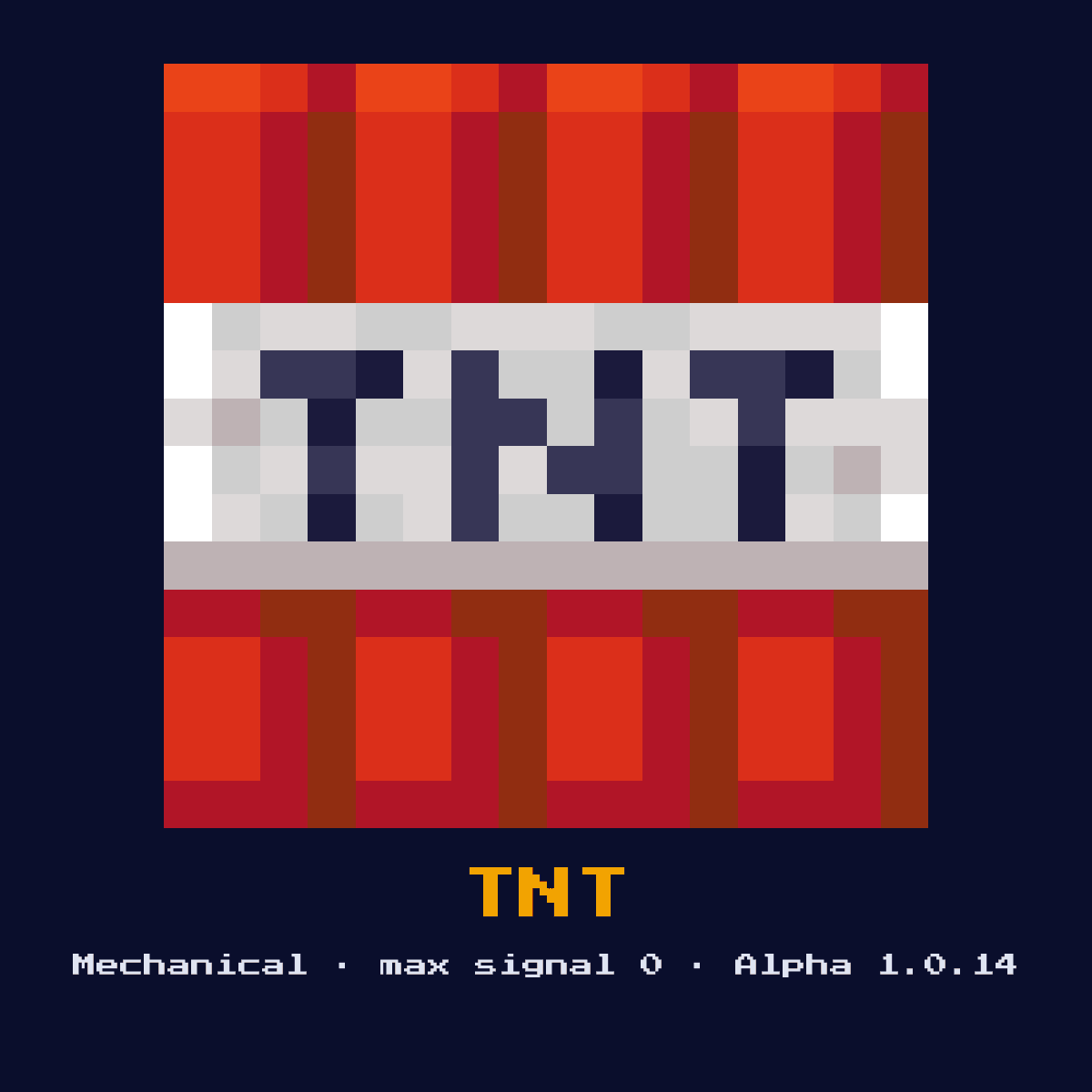
TNT
Ignites when powered by redstone, becoming a primed TNT entity that explodes after 4 seconds (80 game ticks). Destroys blocks and damages entities in blast radius.
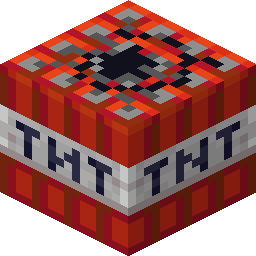
Crafting Recipe
5 Gunpowder + 4 Sand → 1 TNT
Signal Behavior
Input
 Input
InputAny redstone signal ignites it
Output
 Output
None (becomes entity)
Max Signal Strength
0
Delay
4 seconds (80 ticks) fuse
Modes
- Primed (4-second fuse)
What TNT costs you on the crafting grid, exactly
To craft TNT you place 5 Gunpowder and 4 Sand in the shape below, which fills a 3x3 corner of the grid. That is 9 items for a single TNT.
Count on 5 Gunpowder per TNT; that is where 56 percent of the cost sits.
The 3x3 pattern that makes TNT


| TNT is built from | Squares it fills |
|---|---|
| Gunpowder | 5 |
| Sand | 4 |
| TNT you end up with | 1 |
Taken from the TNT crafting recipe in Java Edition 26.2.
What the TNT is, and what it does for you
Ignites when powered by redstone, becoming a primed TNT entity that explodes after 4 seconds (80 game ticks). Destroys blocks and damages entities in blast radius.
As a mechanical component it converts a redstone signal into physical action rather than passing the signal onward. It is the destructive payload behind cannons, mining machines, and trapped vaults.
The version to remember for the TNT is Alpha 1.0.14, when it arrived; this page follows Java Edition 26.2.
Inside the TNT: what the signal actually does
On the input side, any redstone signal ignites it. It returns no redstone signal of its own, its effect is becomes entity.
Any redstone power ignites it, converting the block into a primed TNT entity that explodes after a 4-second (80-game-tick) fuse. Once primed it obeys gravity and can be pushed, which is exactly how TNT cannons launch a projectile charge. The blast destroys nearby redstone wiring, so keep control circuits clear of the radius.
Its output is a pulse, not a held signal: 4 seconds (80 ticks) fuse.
These are the modes you can put the TNT into, and each one changes what comes out: primed (4-second fuse).
How to put a TNT down properly
- 1Craft the TNT: 5 Gunpowder + 4 Sand → 1 TNT.
- 2Set the TNT down facing the way the signal has to travel, on a block that will actually hold it in place, and leave room in front of it for the movement.
- 3Feed it a redstone pulse or signal from a lever, button, or circuit; it will perform its action and ignore further power until the input changes.
- 4Before it goes anywhere near a real build, run the TNT on its own a few times over and check every result against the timing figures listed above this step.
Uses & applications of the TNT
- ▸TNT cannons
- ▸Mining
- ▸Traps
- ▸Blast chambers
- ▸Terrain clearing
Tips & common mistakes
- !Destroys redstone wiring around it
- !Primed TNT is affected by gravity
- !Explosion power varies with distance
- !The 4-second fuse and gravity on primed TNT are what cannons rely on, time the ignition of charge versus projectile carefully or the cannon blows itself up.
The TNT FAQ, answered

What do redstoners actually build with the TNT in Minecraft?
The TNT is most often used for TNT cannons, mining, traps, and blast chambers. As a mechanical component it converts a redstone signal into physical action rather than passing the signal onward.

How far does the TNT push a signal?
The TNT does not output a redstone signal of its own; its result is none (becomes entity). Its purpose is physical action, not signal generation.
What does a TNT cost to make?
5 Gunpowder + 4 Sand → 1 TNT. It was introduced in Alpha 1.0.14.

How long is the TNT's pulse?
4 seconds (80 ticks) fuse. Because it is a pulse rather than a held signal, use an extender if you need the output to last longer, or an edge detector if you need exactly one trigger.
Components that connect to TNT
Follow TNT further into the site through these 6 component pages:
How TNT holds up: hardness, blasts and light level
There is nothing to mine here. TNT sits at hardness 0 and pops off immediately.
Blast resistance matches at 0, so a creeper next to TNT takes it with him. No light comes off TNT, so torch the area around it if that matters.
| TNT | Value in Java Edition |
|---|---|
| TNT hardness | 0 |
| TNT blast resistance | 0 |
| Fastest tool on TNT | no tool in particular |
| Light out of TNT | 0 |