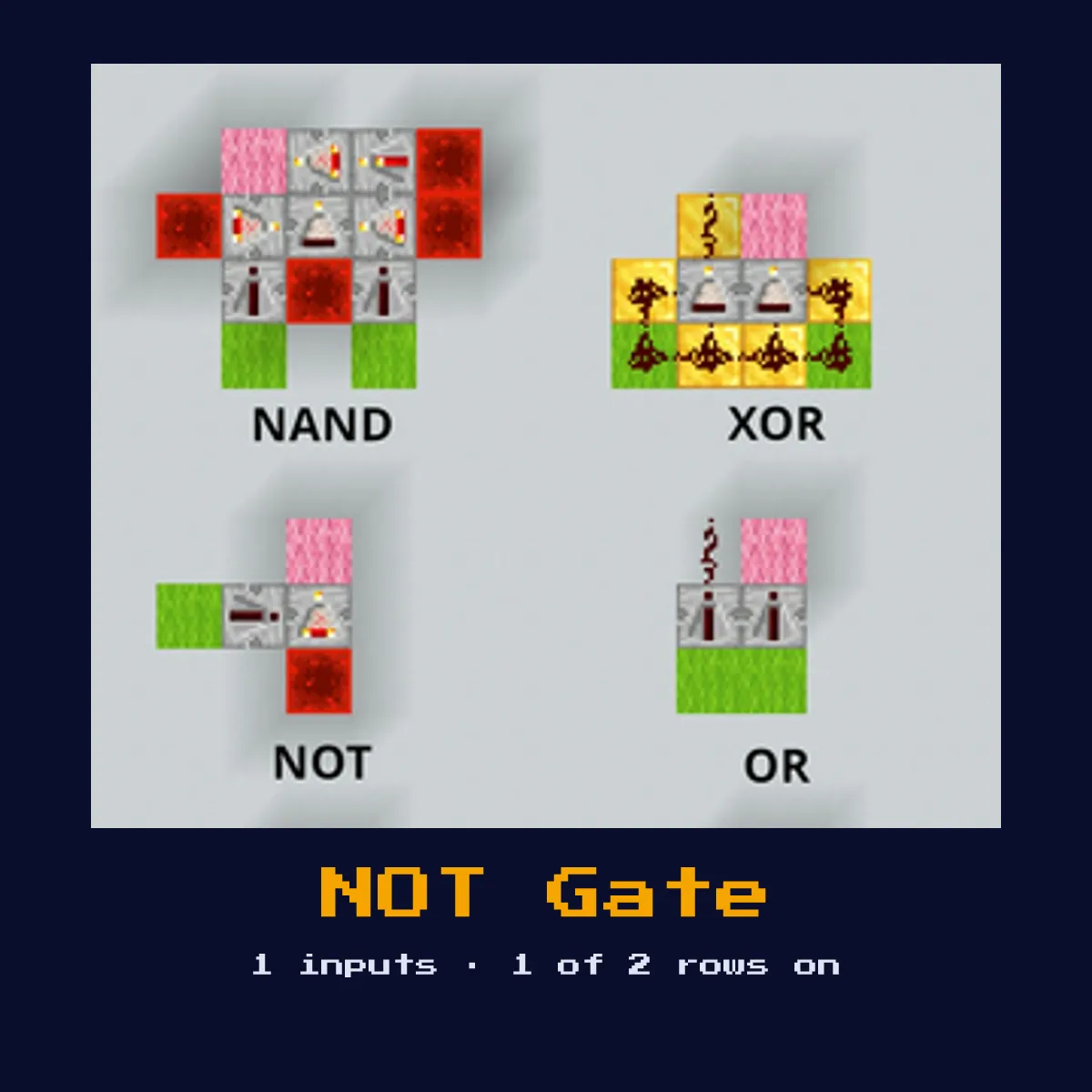
NOT GATE (INVERTER)
The simplest logic gate. Inverts the input signal, when input is ON, output is OFF, and vice versa. Built with a single redstone torch. The foundation for all other gates.

Truth Table
| Input | Output |
|---|---|
| 0 (OFF) | 1 (ON) |
| 1 (ON) | 0 (OFF) |
Reading the NOT Gate (Inverter) truth table
1 of the 2 rows in the NOT Gate (Inverter) table outputs a signal; the other one stays dark.
A NOT Gate (Inverter) outputs power on exactly one input pattern: A off.
What you spend on materials for NOT Gate (Inverter)
Craft every part of a NOT Gate (Inverter) yourself and you spend 2 ingredients, of which 1 Redstone and 1 Stick.
You can read up on Redstone Torch, Redstone Dust and Redstone Comparator separately; those pages carry the delay and power figures this NOT Gate (Inverter) depends on.
| Used in NOT Gate (Inverter) | Amount in a NOT Gate (Inverter) | What one of these costs |
|---|---|---|
 Redstone Torch Redstone Torch | 1 | 1 Redstone, 1 Stick |
 Redstone Comparator Redstone Comparator | as many as the build needs | 3 Redstone Torch, 3 Stone, 1 Quartz |
Add up a whole NOT Gate (Inverter) in ingredients
 1 Redstone
 1 Stick
Recipes behind this NOT Gate (Inverter) table are the ones from Java Edition 26.2.
Start here: what a NOT Gate (Inverter) is and what it does
The simplest logic gate. Inverts the input signal, when input is ON, output is OFF, and vice versa. Built with a single redstone torch. The foundation for all other gates.
In plain terms, the output is simply the opposite of the single input. The NOT gate, or inverter, is the seed every other gate grows from, a single redstone torch on a block is a complete NOT gate, and combinations of inverted signals build AND, NAND, and the rest.
The NOT Gate (Inverter) on this page is the vanilla Java Edition 26.2 gate, with its truth table and its timing exactly as the game plays them, and nothing rounded off.
The logic behind the NOT Gate (Inverter), row by row
Reading its truth table, the output is on when the input is off, and off otherwise.
Expressed as boolean algebra that is output = NOT A.
A torch-on-block NOT gate adds 1 redstone tick (0.1s) of delay as the torch flips state.
A NOT Gate (Inverter) reads incoming power as a plain yes or a plain no: anything from 1 through to 15 counts as a yes, a flat 0 is a no, and the exact number in between never once changes the answer it gives you.
How to build the NOT Gate (Inverter)
- 1Place a solid block (e.g., cobblestone).
- 2Place a redstone torch on the output side of the block.
- 3Run redstone dust into the input side of the block.
- 4When the input is powered, the block becomes powered, turning the torch OFF.
- 5When the input is unpowered, the torch stays ON and outputs signal 15.
- 6Check the NOT Gate (Inverter) row by row against the table. Start with leaving the input unpowered, which has to give ON, then work through the other 1 rows in turn before you call it done.
Uses & applications of the NOT Gate (Inverter)
- ▸The NOT gate, or inverter, is the seed every other gate grows from, a single redstone torch on a block is a complete NOT gate, and combinations of inverted signals build AND, NAND, and the rest.
- ▸Torch on block (classic, 1 torch, 1 block), a practical build choice for this gate.
- ▸Torch on wall (attached to side of block), a practical build choice for this gate.
- ▸Comparator-based inverter (subtract mode with side input of 15), a practical build choice for this gate.
Tips & common mistakes
- !A repeater on each input of the NOT Gate (Inverter) costs you two ticks and saves an hour of debugging later, because dust that feeds backwards into its own line is what quietly breaks most gates.
- !Remember the propagation cost: A torch-on-block NOT gate adds 1 redstone tick (0.1s) of delay as the torch flips state. If you chain several gates, those ticks add up and can desynchronise a fast circuit.
- !Pull the NOT Gate (Inverter) out of the circuit and test it on its own against all 2 rows of the table; a gate that passes alone points the finger straight at the wiring around it.
NOT Gate (Inverter), frequently asked questions
What does a NOT Gate (Inverter) do in Minecraft?
A NOT Gate (Inverter) outputs a signal where the output is simply the opposite of the single input. In boolean terms, output = NOT A.

What is the truth table of a NOT Gate (Inverter)?
Reading its truth table, the output is on when the input is off, and off otherwise. The boolean expression is output = NOT A.
How do you build a NOT Gate (Inverter) with redstone?
Place a solid block (e.g., cobblestone). Place a redstone torch on the output side of the block. Common variants include torch on block (classic, 1 torch, 1 block) and torch on wall (attached to side of block).

How much delay does a NOT Gate (Inverter) add?
A torch-on-block NOT gate adds 1 redstone tick (0.1s) of delay as the torch flips state. That matters most in clocks and adders where every redstone tick counts.
Is a single redstone torch really a NOT gate?
Yes. A redstone torch on the side of a block outputs signal 15 when the block is unpowered and goes dark when the block is powered. That on-when-off, off-when-on behaviour is the complete definition of a NOT gate, making the torch the simplest gate in the game.